Chess: Microcosm of Alchemy[1]
By Matthew J. Bell
(July 23, 2013)
The World Chess Hall of Fame in St. Louis presents visitors with a unique set of experiences. Besides affording, via an almost unrivaled assortment of rare artifacts currently on display, a glimpse into the colorful history and development of the game of chess, the wonderful objects in Chess Museum also became for me an impetus for self-reflection. Perhaps curiously, my visit to the Chess Museum was an occasion for speculating on the mystifying topic of initiation into particular streams of esotercism. Although, given the diverse range of occult meanings that has been attached to the game of chess, perhaps this is not so peculiar after all.
Open to the public in a three story building on Maryland Avenue in the Central West End neighborhood of St. Louis, the Chess Museum contains a number of surprises. At the time of my visit, during the summer of 2013, the tour opened, more or less on the ground floor, to an exhibition of the provocative techno-minimalist sculptures of Bill Smith.
According to a free promotional pamphlet,[2] as well as the intriguing commentary from the exuberant young guide, Smith was partly taken with the notion that the game of chess, something of an epitome of low-key conflict, is an “[elegant]… microcosm” of the sort of titantic struggle-for-survival that one observes in nature.
Smith invokes this concept of the so-called microcosm “[i]n order…to show the underlying similarities of all things.”[3] This idea is complex. A bit of unpacking might be helpful.
“As below, so above; and as above so below. With this knowledge alone you may work miracles.” - The Emerald Tablet[4]
Microcosm/Macrocosm
The word “microcosm” literally and exoterically designates a “miniature world”[5] and is juxtaposed with the “macrocosm” or “the great world,” that is, the universe.[6]
Metaphorically, the microcosm-macrocosm pair is pregnant with esoteric significance. One can trace this, like Ariadne’s thread,[7] through a historical maze of occultic-hermetic traditions.
Alchemy
Consider first the arcane discipline of alchemy.[8] Alchemy is a difficult enterprise to describe concisely. Even the etymology of the name itself is a matter of some contention. According to one proposed derivation, our modern term comes from the “Arabic [word] al-kimiya, [and] from [the Greek word] khemeioa…found c.300 C.E. in a decree of Diocletian against ‘the old writings of the Egyptians’), all meaning ‘alchemy.’ Perhaps from an old name for Egypt…Khemia, lit. ‘land of black earth,’ found in Plutarch…”.[9] One might say that alchemy is the art and (proto)science of transformation. [See image #1.]

“One of the most famous of all alchemical axioms is ‘as above, so below’ – meaning always that in every small part of reality there is a tiny reflection of the great ‘over-structure’[10] of reality. And, in the largest structures, are hidden secrets of the smallest. And vice versa.”[11]
In a little circular presented to the public, the layout for Bill Smith’s works is presented diagram-matically with a trio of prominent shapes: circle, triangle, and square.[12] [See image #2.]
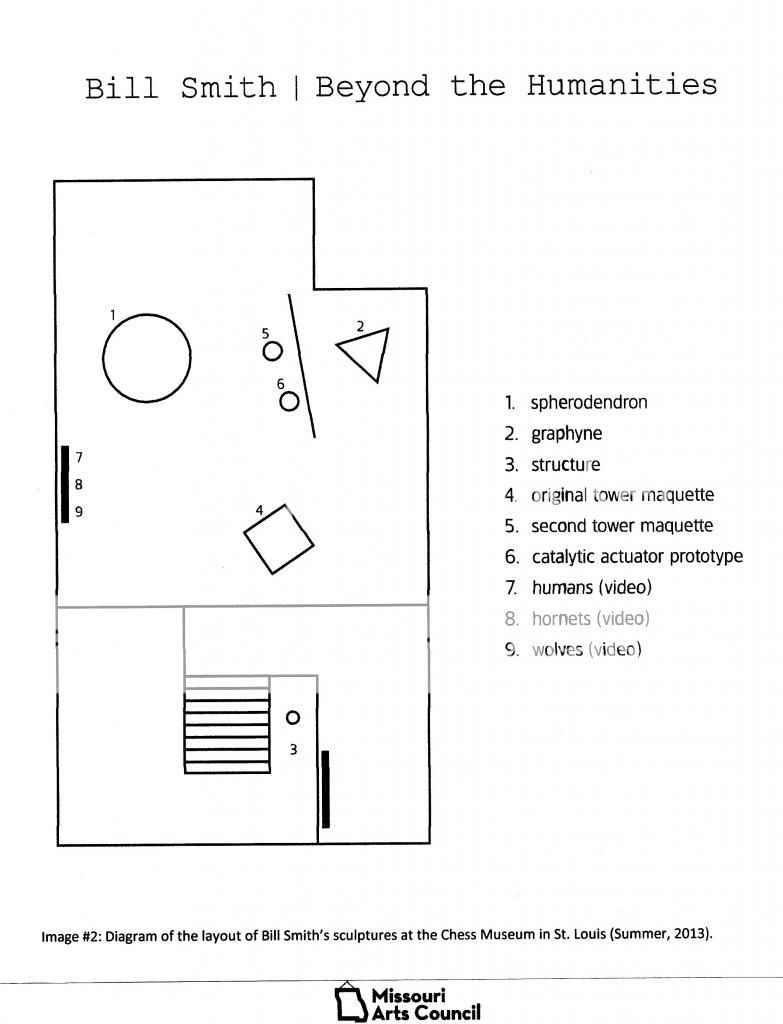
This might be written off as trivial, since these are amongst the commonest of geometrical forms, were it not that the alchemist Michael Maier, represents the fabled “philosopher’s stone” with just such a combination.[13] Masonic author Timothy Hogan elaborates: “The philosopher’s Stone itself was always symbolized by a perfect cubic stone, which is a familiar symbol in the symbolic lodge of Masonry… The other symbol [that the Philosopher’s Stone] was sometimes depicted as was a circle, square, and triangle interlaced.”[14] [See image #3.]

To put a finer point on this, one may turn to Freemasonic encyclopedist, Albert G. Mackey. Mackey relates that the macrocosm is “[t]he visible system of worlds; the outer world or universe. It is opposed to Microcosm, the little world, as in man.”[15] Hence, esoterically, the microcosm is the human being him- or herself. “The alchemical vessel of transformation is the body and the head of the experient.”[16] Furthermore, the alchemical transformations are, in some sense, depicted or effected by “sacred geometry.”[17]
Kabbalah
The relevant syzygy also surfaces in the Jewish magico-mystical tradition of Kabbalah.[18] “The Jewish patriarchs taught that the human body was the microcosm, or little cosmos, made in the image of the macrocosm, or the great cosmos.”[19]
This dichotomy or, perhaps more precisely, this scalar concept, whose visual analog is arguably the fractal,[20] is cashed out in two main ways.
First, prominent in various streams of Kabbalah is the notion of the harmonia mundi (the “harmony of the universe”).[21] In this conception, developed in the important Kabbalistic treatise, Sefer Yezira (“the book of creation”),[22] all things are in some abstruse sense struct-urally isomorphic. “There are three layers of existence, the cosmic, that of time, and that of man.”[23] This was further developed by the “Christian Kabbalist,” Francesco Giorgi, in his 1525 work, De harmonia mundi totius.[24]
According to our “as above, so below” maxim, teased out in quasi-Christian terminology, these three layers of existence have relevant analogs. “According to the Mystery Schools, the human body is divided into three major parts, and in analogy with this, the universe is said to be composed of three worlds: heaven, earth, and hell.”[25]
With respect to human beings in particular, Manly Hall speaks of “the three worlds” and asserts that “[t]hese centers are the brain, the heart, and the reproductive system.”[26] Hall links this tripartite arrangement with the three-degree structure of Craft, or Blue Lodge, Freemasonry: “…the entered apprentice, Fellowcraft, and Master [Mason]…”.[27]
As previously reported, the Chess Museum spans three levels. Smith’s artwork presently occupies the first level, where, to draw an analogy, the chess apprentice is generated and encouraged to make the trip upward. In this “Opening,” the mostly dark space contains the “Spherodendron,” or circle-tree, an emblem of the complex journey that lies ahead, with all of its myriad, ramifying paths. Also facing the candidate is the triangular-pyramidal-tetraktal “Graphyne” and the tower structures, instructions and signposts, to the occult observer. On the “ladder” upwards to chess virtuosity, the aspirant traverses a tessellated landscape, figuratively represented by the various checkered boards and pieces on display at the second level. On these boards, during our figurative “Middle Game,” “[w]hat takes place is a battle between black pieces and white pieces, between light and darkness…”.[28] This gigantomachy filters the unworthy from the worthy – the latter showcased by the chess masters commemorated on the third level Hall of Fame. This is the “End Game.”
Second, “[t]he book [Sifra di-Tseniutha, or the ‘Book of Concealment’] concerns itself with the manifestation of the Macroprosopus,[29] the ‘Greater Countenance,’ which came into being as a symbol of harmony after the equilibrium of the universe had been established. This Macroprosopus is ever-concealed but expands itself to yield the Microprosopus, or ‘Lesser Countenance’ who is known by the Tetragrammaton, IHVH.”[30] “‘The Book of Concealed Mystery’ comprises the first part of [Christian] Rosenroth’s Kabbalah Denudata…”.[31]
For present purposes, I wish to highlight the fact that, in Kabbalah, “…the Microprosopus is androgyne [sic.].”[32] In Jewish mythology, some “…hold that Adam [the first man] was originally created as an androgyne of male and female bodies joined back to back.”[33] One of the names for this “original man,” Adam Kadmon, was “…diprosopon, ‘two-faced’.”[34]
“The sexes were not two as they are now, but originally three in number; there was man, woman, and the union of the two…[the Androgyne]…[35] [T]he primeval man was round, his back and sides forming a circle…” – Plato, Symposium [36]
In alchemy, the androgyne[37] “…rules over the conjunction of opposites.”[38] Symbolically, the androgyne is related to the hermaphrodite. The youth Hermaphroditos is the offspring of Venus-Aphrodite and Mercury-Hermes. Of course, “Hermes” (Mercury, Thoth) is the god whose name lends itself to the Alchemical word Hermetic. Furthermore, Venus (Aphrodite; cf. Eos, Aurora, the “dawn goddess”) is the “Morning Star” otherwise known as the Lucifer (i.e., “Light-Bringer,” Phosphorus). [See image #4.]

It is apparent that the hermaphrodite was created through a transformation.[39] As Ovid related, the hermaphrodite is a result of a quasi-sexual conjunction of Hermaphroditos and a nymph named Salmacis. The relevant transformative process may be brought about by means of the “Caduceus,” or the double-serpent entwined wand of Hermes – which wand, to employ the familiar modern lingo, demonstrated peculiar “sex-change” powers in the case of the mythological Tiresias.[40] He was changed from male to female and back again after “separating” two “copulating snakes” by means of placing his “staff” (caduceus) in between them.[41]
The androgyne-hermaphrodite is a representation of the bringing together of opposites – the alchemical coniunctio oppositorum. Especially given his invocation of the “microcosm,” Bill Smith’s work titled “Spherodendron” is highly reminiscent of the “primeval man’s” spheroidal shape, according to Aristophanes’ account in Plato’s Symposium.[42] Additionally, the game of chess, bringing together opposing sides of light and dark, often ends with opposing king-queen pairs in a sort of conjunction. [See image #5.]

The androgyne, in its two-headed Rebis form (“rebis,” “two-thing” or “dual-thing”), is an emblem for the generation of the “Child of the Philosophers,” yet another portrayal of the Philosopher’s Stone and the culmination of the alchemical magnum opus (“great work”). This “child” is variously understood. Enumerating the different interpretations is beyond my present scope.[43] Suffice it to say that one important emblem for the transformative procedure is supposedly encoded in the so-called “Pythagorean sex triangle.”[44] Again, the supposed secrets of transformation seem to revolve dually around the sexual and the geometric, like the two foci of the elliptical orbit a planet takes around the sun.[45] [See image #6.]

Besides the other representations for the philosopher’s stone that have been rehearsed already, another veiled reference to its preparation was “squaring the circle.”[46] Tying some of these seemingly disparate strands together, a few authors have claimed that “[a] Chessboard solves the problem of ‘Squaring the Circle’.”[47] [See image #7.]
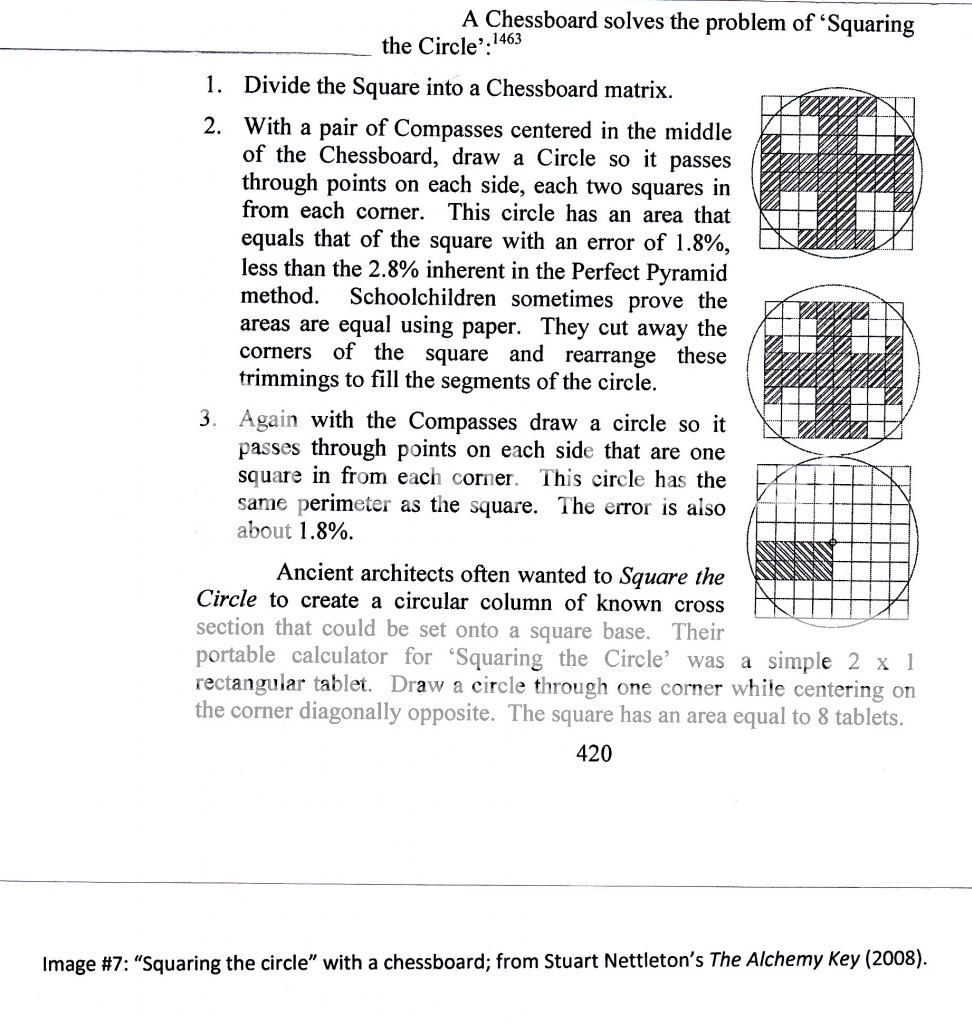
For readers’ information: “Squaring the circle, constructing a square equal in area to a given circle, is one of the three classic unsolved problems of antiquity.”[48] Writer Stuart Nettleton reproduces a set of diagrams illustrating the geometrical method (the details of which shall not detain us) for inscribing a circle around the 64 (4-cubed) one-by-one squares of a chessboard in order to facilitate a ‘squared-circle’ transformation.[49]
Spy-craft
As the visitor makes his or her way upward to the second floor of the museum, en route to the masters enshrined on the third floor, he or she is confronted with numerous chess sets, all varying in terms of design and even, in a few cases, configuration. Many of these come from India, the cradle of the game of chess – termed the noble jeu (the “noble game”) by, for example, the composer and chess innovator, François-André Danican Philidor.[50]
Le noble jeu is also a metaphor for le grand jeu, “the great game.” Coined by Arthur Conolly and popularized by Rudyard Kipling[51] in his novel, Kim,[52] “the great game” historically designated the struggle, first by Britain and Russia, then by the U.S. and the U.S.S.R., for control over central Asia, for which India was a useful staging ground.[53],[54] [See image #8.]

Not merely a relic of the past, “the great game” and its symbolization can be glimpsed in Zbigniew Brzeziński’s 1998 book, The Grand Chessboard.[55] In his book, Brzeziński, former National Security advisor to Jimmy Carter and co-founder, with David Rockefeller, of the Trilateral Commission, outlines his geo-strategy for securing U.S. hegemony over central Asia. The chess analogy is patent and not without precedent. [See image #9.]

“During the Second World War, …Adolf Hitler and Joseph Stalin moved around entire populations like pieces on a chessboard, seeking to reshape the demographic profile of Europe according to their own preferences.”[56]
In an obituary for the ex-Central Intelligence Agency[57] “clandestine service” chief “who oversaw all global espionage activities for the agency in the mid-1980s”,[58] the author said the following. “Clair E. George…[was] a consummate spymaster who moved the chess pieces in the Central Intelligence Agency’s clandestine games of intrigue before being convicted of lying to Congress about the Iran-contra affair…”.[59]
Examples of this tropology can be multiplied.
“You see there is only one constant. One universal. It is the only real truth. Causality. Action, reaction. Cause and effect.” - The Merovingian (The Matrix Reloaded)
The underlying gnosis might be ascertained by way of a passage in a strange little book. First published in 1908, the Kybalion: A Study of The Hermetic Philosophy of Ancient Egypt and Greece is a hermetic and pseudo-psychological mish-mash. Authorship is merely and mys-teriously attributed to “Three Initiates” who claim to convey to readers, in concise terms, the philosophy of the legendary wellspring of alchemy, Hermes Trismegistus. The treatise touches upon several points that resonate with historic occult currents.
In the section titled, “The Principle of Cause and Effect,” we read:
“‘Every Cause has its Effect; every Effect has its Cause; everything happens according to Law; Chance is but a name for Law not recognized; there are many planes of causation, but nothing escapes the Law.’ – The Kybalion. This Principle embodies the fact that there is a Cause for every Effect; an Effect from every Cause. It explains that: ‘Everything Happens according to Law’; that nothing ever ‘merely happens’; that there is no such thing as Chance; that while there are various planes of Cause and Effect, the higher dominating the lower planes, still nothing ever entirely escapes the Law. The Hermetists understand the art and methods of rising above the ordinary plane of Cause and Effect, to a certain degree, and by mentally rising to a higher plane they become Causers instead of Effects. The masses of people are carried along, obedient to environment; the wills and desires of others stronger than themselves; heredity; suggestion; and other outward causes moving them about like pawns on the Chessboard of Life. But the Masters, rising to the plane above, dominate their moods, characters, qualities, and powers, as well as the environment surrounding them, and become Movers instead of pawns. They help to PLAY THE GAME OF LIFE, instead of being played and moved about by other wills and environment. They USE the Principle instead of being its tools. The Masters obey the Causation of the higher planes, but they help to RULE on their own plane. In this statement there is condensed a wealth of Hermetic knowledge – let him read who can.”[60]
One sees, therefore, another theme brought out by Bill Smith. The “rules of chess,” likened to the “natural law,” the “laws of survival,” and suchlike, are at once deterministic and suggestive of a hierarchy (for example of major pieces over minor pieces over pawns). Plausibly, the hierarchy is established by this: Those who know and excel at exploiting the “rules of the game,” moving the pieces around the board to achieve their killing-of-the-king objective, stand above those who either do not know or do not excel at exploiting said rules. To again quote the Merovingian: “Choice is an illusion created between those with power and those without.”[61]
In this way, then, the game of chess is not simply symbolic of some other initiation process. Arguably, it is, in and of itself, an initiation rite.
“[T]he frequent occurrence of Chess in Grail Castles and Magic Castles throughout the legends, in some of which the chessmen play the game themselves without visible handling, is really another of the innumerable disguises under which the Magic and Initiation appear. The whole story is really a sort of glorified game of chess, in which we have Kings and Queens and Knights and Bishops and Pawns under various forms and in various positions. …The maze pattern is represented by the squares of the chessboard and the moves of the pieces to and fro, from square to square.”[62] [See image #10.]

Note:
[1] This paper will be considering the Chess Museum from the perspective of its contents and layout in a way that has something in common with the approach so-called “psychogeographers” take toward certain cityscapes. During this voyage, I will entertain various interpretations for symbolically suggestive aspects of the Chess Museum. It is important to note that I make no claims about the intentions of the designers, owners, sponsors, staff, or anyone else with a connexion to said establishment. Moreover, my remarks about the artwork of Bill Smith should be understood in this light: I am engaged in an exercise that is purely one of reflection and speculation on certain archetypal forms and features as they occur in or around the museum. Intentions and motivations are obscure things. Sometimes I am not sure that I know my own, let alone those of anyone else. This work is for informational or entertainment purposes only. Furthermore, my descriptions of various occult concepts should not be construed as endorsements of those concepts.
[2] “Bill Smith | Beyond the Humanities: March 7 – September 15, 2013,” pamphlet, World Chess hall of Fame, p. 5.
[3] Ibid.
[4] Fulcanelli’s version, Paul Sieveking, trans., <http://www.sacred-texts.com/alc/emerald.htm>.
[5] Douglas Harper, “Microcosm,” Online Etymology Dictionary, <http://www.etymonline.com/index.php?allowed_in_frame=0&search=microcosm>.
[6] Douglas Harper, “Macrocosm,” Online Etymology Dictionary, <http://www.etymonline.com/index.php?allowed_in_frame=0&search=macrocosm>.
[7] “Now, before Daedalus left Crete, he had given Ariadne a magic ball of thread, and instructed her how to enter and Labyrinth. She must open the entrance door and tie the loose thread to the lintel; the ball would then roll along, diminishing as it went and making, with devious turns and twists, for the corners where the Minotaur was lodged. This ball Ariadne gave to Theseus and instructed him to follow it until he reached the sleeping monster, whom he must seize by the hair and sacrifice to Poseidon. He then can come back by rolling up the thread into a ball again.” Robert Graves, The Greek Myths, London: Penguin, 1992, §98.k, p. 339. Incidentally, “Ariadne” is a character, played by Canadian actress Ellen Page, in the 2010 movie, Inception. As the plot unfolds, and in order to differentiate waking and dreaming experience, Ariadne fashions for herself a “totem” in the shape of a chess piece – a bishop. In Through the Looking Glass, acted out atop a world-wide chessboard, the Red King was also a dreamer, like the Matrix (1999) character, Morpheus. Morpheus asks: “Have you ever had a dream, Neo, that you were so sure was real? What if you were unable to wake from that dream? How would you know the difference between the dream world and the real world?” Similarly, Carroll writes: “‘[The Red King’s] dreaming now,’ said Tweedledee: ‘and what do you think he’s dreaming about?’ ... ‘Why, about YOU [Alice]!’ Tweedledee exclaimed, clapping his hands triumphantly. ‘And if he left off dreaming about you, where do you suppose you’d be?’ ... ‘you’d go out—bang!—just like a candle!’“ Like Inception’s Ariadne, Alice also seems to have difficulty tracking the distinction between dreams and reality. She exclaims: “Only I do hope it’s MY dream, and not the Red King’s!”
[8] For more on alchemy, see Jim Brandon, Rebirth of Pan, Dunlap, Ill.: Firebird Press, 1983 and Aleister Crowley, The Book of Thoth, New York: Samuel Samuel Weiser, 1993.
[9] Douglas Harper, “Alchemy,” Online Etymology Dictionary, <http://www.etymonline.com/index.php?term=alchemy>. Cf. <http://dictionary.reference.com/browse/alchemy>.
[10] This is also called “the Pattern.” See Dennis William Hauck, The Complete Idiot’s Guide to Alchemy, New York: Penguin, 2008, p. 23. Nota bene: “A chessboard is a pattern, and the word almost literally means ‘King’s Maze’ (for ‘chess’ is Sháh, Persian for ‘King’), and so ‘Initiation Pattern’,” Robert W. Crutwell, “The Initiation Pattern and the Grail,” Folklore, vol. 49, no. 3, Sept., 1938, p. 250. The emphasis on the word “is” occurs in the original.
[11] Terence McKenna, in Sheldon Rochlin, The Alchemical Dream: Rebirth of The Great Work, video, 2008. This is represented pictorially by the 16th-17th century Rosicrucian and Kabbalist, Robert Fludd, in his Utriusque Cosmi Historia (1617) and by Fludd’s contemporary, the alchemist, Johann Daniel Mylius, in the Opus Medico-Chymicum (1618).
[12] “Bill smith | Beyond the Humanities,” handout, Missouri Arts Council. The circle locates the artwork titled “Spherodendron,” the triangle represents “Graphyne,” and the square “Original Tower Maquette.” Elsewhere, there is a much taller tower sculpture named “Structure,” which extends from the ground level upwards, adjacent to the staircase. I have no space, presently, to discuss the (obviously partly phallic) symbolism of towers. For some mention of historically important towers, the interested reader can consult Matthew Bell, with Jim Brandon, “Star Trek In Tenebris,” Bell Curve [weblog], June 5, 2013, <http://curveofbell.blogspot.com/2013/06/star-trek-in-tenebris_5.html> and John A. Keel, The Eighth Tower, Saturday Review Press, 1975.
[13] See his Atalanta Fugiens: The Fleeing of Atalanta, or New Chymical Emblems of the Secrets of Nature, Oppenheim, Germany: Johann Theodor de Bry, 1618, Emblemma XXI. Underneath, Maier’s accompanying Epigramma reads: “From man and woman, make you a single circle; From which rises the square with its equal sides; Build a triangle of it, turned itself; In a rounded sphere. The Stone then is born. If your mind is slow to catch that mystery, Understand the work of the geometer and you will know.” Manly P. Hall reproduces this image on the title page of his monograph titled, The Occult Anatomy of Man & Occult Masonry, Los Angeles: Philosophical Research Society, 1997; cf. ibid., p. 4. Elsewhere, Hall explains that Freemason’s “Great Architect of the Universe” “builds…bodies…around lines of force” using “[g]eometry…[as] the skeleton…”, ibid., p. 31.
[14] The Alchemical Keys to Masonic Ritual, privately published, 2007, p. 26. It is apparent that part of the “mastery” of the hermetic-masonic “arts” includes the acquisition of the knowledge of how to interlace these forms correctly. Again deferring to Hogan, he writes that “the Master Mason’s apron is a square with an inverted triangle in it.” Hence, in the ground floor layout, the shapes are separated. These are perhaps interpretable as the raw-materials for the construction of the philosopher’s stone. The correct assembly of the materials is the province, one might believe, of the chess masters celebrated on the third level. The fountainhead for the geometrical basis of phenomenal order is arguably Plato’s dialogue Timaeus.
[15] “Macrocosm,” Encyclopedia of Freemasonry, Chicago: Masonic History Co., 1956, p. 609.
[16] That is, the percipient, the person undergoing the alchemical experience. McKenna, loc. cit.
[17] The Pythagoreans are a well-known embodiment of this. Pythagoras’ maxim that “all is number,” along with his “47th proposition” or “Pythagorean theorem” (venerated by Freemasons and also called the “47th problem of Euclid”) and his “tetraktys” (which supposedly “…contained the knowledge of all things when set out in the shape of a triangle with ten dots disposed pyramidally at four levels”, “Tetraktys,” in Jean Chevalier and Alain Gheerbrant, The Penguin Dictionary of Symbols, John Buchanan-Brown, trans., London: Penguin, 1994, p. 984) all testify to this. Additionally, we see this close-alchemical-geometrical connexion in the work of the 8th century figure Jabir ibn Hayyan, from whose name (and writings) we get the word “gibberish”, Hauck, op. cit., p. 38. Jabir was a mathematician and geometer as well as a magician, astrologer, and alchemist, see Stanton J. Linden, The Alchemy Reader: From Hermes Trismegistus to Isaac Newton, Cambridge, U.K.: Cambridge Univ. Press, 2003, p. 80. Jabir’s Arabic predecessor, the 7th century Khalid ibn Yazid, explicitly exhorts his readers: “…learn to understand geometrical proportion…”, ibid., p. 73.
[18] Lit., “that which has been received”, Dan, op. cit., p. 4. Prominent “Kabbalistic” works include the Sefer Yezira (“book of creation”), Sefer Ha’Bahir (the “book Bahir,” “book of brightness”), Sefer Ha’Zohar (the Zohar, “book of splendor,” which collection includes, as proper parts, the Midrash ha’Neelam and the Idra Rabba and Idra Zuta works), and the later the Tikuney Zohar and Zohar ha’Dash (emendations and appendices to the Zohar proper), see Dan, ibid., passim. For a pithy overview, see “Kabbalah,” Joseph Telushkin. Jewish Literacy: The Most Important Things to Know About the Jewish Religion, Its People and Its History, New York: William Morrow & Co., 1991, reproduced online, Jewish Virtual Library, <http://www.jewishvirtuallibrary.org/jsource/Judaism/kabbalah.html>.
[19] Hall, op. cit., p. 5. This reference to the “Jewish patriarchs” is best understood as being “extra-biblical” and to proceed from certain mystical and gnostic currents within Judaism and Judaized Christianity. Traditional forms of Christianity – Catholicism, Orthodoxy, and Protestantism – do not accept these claims regarding the “patriarchs.”
[20] Anticipating the cooption and explication of fractal imagery in the so-called “chaos theory,” Michael Maier’s associate, alchemist Heinrich Khunrath, put chaos in the center of creation, crowned by the androgyne – or “man-woman,” the alchemical rebis – in his engraving, “The hermaphrodite,” in Amphitheatrum sapientiae aeternae, Hamburg, Germany, 1595. The “rebis,” or “dual-thing,” is, like the geometrical arrangements considered above, another depiction of the philosopher’s stone.
[21] Joseph Dan, Kabbalah: A Very Short Introduction, Oxford: Oxford Univ. Press, 2006, p. 19.
[22] The date of this composition is unknown. Dan reports that minority views hold that it was written as early as the 1st A.D. and as late as the 9th century A.D., with the majority of scholars holding to the view that it belongs somewhere in the 3rd-4th A.D. century range. Ibid., pp. 17-18.
[23] Ibid., p. 19.
[24] “[T]he relationships between micro-cosmos and macrocosmos, and between man and Creator in whose image he was created, were developed in various schools of neo-Platonists during the Middle Ages”, Dan, op. cit., p. 68. Besides Giorgi, notable Christian Kabbalists included, without limitation, Marsilio Ficino (also a neoplatonist and historically important translator of Plato), Pico dela Mirandola (author of the “900 theses” that preceded Martin Luther), Johannes Reuchlin, Cornelius Agrippa (prototype for Johann Goethe’s Faustus), Guillame Postel (about whom I have written elsewhere, see my “Going ‘Postel’: The Making of a ‘Judeo-Christian’,” Church Bell [weblog], September 25, 2012), and Christian Knorr von Rosenroth (author of the Kabbalah Denudata [1677-84], later popularized by Hermetic Order of the Golden Dawn occultist Samuel Liddell MacGregor Mathers in 1877 as The Kabbalah Unveiled).
[25] Hall, op. cit., p. 11.
[26] Ibid., p. 14.
[27] Ibid.
[28] Chevalier and Gheerbrant, op. cit., p.189. The game of chess and the chess board are both symbols for trial and tribulation. For example, in Lewis Carroll’s story, Through the Looking-Glass, and What Alice Found There (1871), the plot unfolds upon a vast checkerboard landscape where the main characters are stylized chess pieces. Toward the end of the Shakespearean play, The Tempest, Ferdinand and Miranda play a game of chess. Additionally, in his classic film, Det sjunde inseglet (“The Seventh Seal”), director Ingmar Bergman illustrates the human struggle to avoid death with a prolonged chess game between a knight named Antonius Block (Max von Sydow) and the hooded figure of Death (Bengt Ekerot). More recently, chess matches, and the idea of chess mastery, are interwoven in the plot of the 2005 Guy Ritchie movie, Revolver.
[29] “The Hebrew name of the Macroprosopus is Arikh Anpin, which translates into ‘The Long Face’ or ‘The Greater Countenance’…[or] ‘The Long Suffering.’” Charles Poncé, Kabbalah, Wheaton, Illinois: Theosophical Pub. House, 1973, p. 113. The Kabbalistic “Tree of Life,” with its ten (visible) Sephirot, or “emanations” of the invisible “Infinite,” Ayn Sof. Incidentally, “…Ariadne, the Cretan goddess, is said to have hanged herself [from a sacred tree]…as the Attic Erigone did…”, Graves, op. cit., §88.10, p. 298.
[30] Poncé, op. cit., pp. 47-8. The Tetragrammaton, or the “four letters,” יהוה, IHVH (IeHoVaH, Jehovah), are also represented as YHWH (YaHWeH, Yahweh). This is because ancient Hebrew did not include vowels. Vowel “pointing” was a later development. Christian Kabbalism was fascinated with voces magicae (“word magic,” “voice magic”), or what the ancient Egyptians termed “words of power” (heka). “…Christian Kabbalists…adopt[ed] the belief in the ability of language – especially names, and in particular divine names – to influence reality”, Dan, op. cit., pp. 66 & 68. Bill Smith’s sculpture “Graphyne,” although stated to be a representation of the artificial carbon allotrope by the same name, is also a portmanteau – like “Spherodendron.” “Graphyne” could be decomposed into “graph” (“write”) and “-yne”, a chemical suffix closely akin to the word “dyne,” meaning power. Perhaps it is coincidental that Bill Smith chose to create a visual homage to a molecule whose name might be supposed to convey the notion of power-writing.
[31] Ibid., p. 48.
[32] Ibid., p. 127. “The thirty-two paths of the sefirothic configuration are contained in man”, ibid., p. 165. On the “thirty-two paths,” as opposed to the twenty-two paths enumerated by other more modern writers (e.g., “Tree of Life,” Thelemapedia, <http://www.thelemapedia.org/index.php/Tree_of_Life>), see Rawn Clark, “The 32 Paths of Wisdom,” Journal of the Western Mystery Tradition, vol. 1., no. 3, Autumnal Equinox, 2002, <http://www.jwmt.org/v1n3/32paths.html>.
[33] Robert Graves and Raphael Patai, Hebrew Myths, Manchester, U.K.: Carcanet Press, 2005, p. 66.
[34] Ibid., p. 67, n. 2.
[35] It appears to me that this is account serves as one – and possibly the – metaphysical basis for contemporary notions such as the romantic idea of “finding one’s soul-mate” as well as pseudo-psychological musings that invoke the concept of “discovering one’s ‘inner femininity/masculinity’,” etc. This has alchemical analogs as well. See Paracelsus’ comment on Genesis 2:21-22: “…their Adam, who carryes his invisible Eve hidden in his own body…”, quoted in Linden, op. cit., p. 166.
[36] Benjamin Jowett, trans., 189e. See <http://classics.mit.edu/Plato/symposium.html>. Symbolically considered, the sphere is of a piece with the circle “…and shares its symbolism… The sphere is…the cube of the circle…[and symbolizes the] bridge or marriage between Heaven and Earth…”, Chevalier & Gheerbant, op. cit., pp. 901-2. Some of these themes bubble under the surface in the 1998 science fiction thriller, Sphere.
[37] For more on the androgyne, the interested reader should consult: Jim Brandon, “Neil Armstrong: Astronaut . . . or Alchemist?” Bell Curve, Dec. 11, 2012, <http://curveofbell.blogspot.com/2012/12/neil-armstrong-astronaut-or-alchemist.html>, Matthew Bell, Per Meum Vitra, work-in-progress, draft, February 6, 2013, and Matthew Bell, “Now Playing at the Century 16 Ampitheater of Eternal Wisdom: Aurora Consurgens, Part 2,” Bell Curve, Sept. 1, 2012, <http://curveofbell.blogspot.com/2012/09/now-playing-at-century-16-ampitheater.html>.
[38] James Shelby Downard, “Sirius Rising,” Jim Brandon, audio interview, with commentary, ca. 1976.
[39] Recall that this was our provisional, albeit minimalist, definition for the word “alchemy.”
[40] Hauck, op. cit., p. 21.
[41] The symbol of the caduceus is closely related to the “rod of Asclepius” oft-used as a medical emblem as well as the dollar-sign, “$”.
[42] The neologism “Spherodendron” appears to be something like a portmanteau word from “sphere” and “dendron,” meaning tree, as in “rhododendron,” or red-tree/rose-tree. (The rhododendron, by the way, is a symbol of warning or danger – fitting for a level-one initiate. See ““RHODODENDRON [Rose bay],” Cora Linn Daniels and C. M. Stevans, eds., Encyclopedia of Superstitions, Folklore, and the Occult Sciences, vol. 2, Milwaukee, Wisconsin: J.H. Yewdale & Sons Co., 1903, p. 797.) The Kabbalistic “Tree of Life” has already been mentioned, above. One way to construe this is as an explication of the “Pattern” or cosmic-”overstructure.” On this interpretation, the world is organized according to “the Tree of Life,” with the various sephiroth manifesting, so to speak, on different planes of existence. This “tree” also represents the path to occult knowledge – gnosis/da’at – that is, the path to one’s own (supposed) latent divinity. Here one could mention the “serpent” in the Garden of Eden – Lucifer, the “light-bearer” – hanging from the “tree of the knowledge of good and evil” and symbolizing “enlightenment,” according to theosophist Helena P. Blavatsky, Freemason Albert Pike, and others. See Blavatsky’s Theosophical magazine, “Lucifer,” <http://www.blavatskyarchives.com/luciferreprints.htm> and Pike’s Morals and Dogma, Richmond, Virginia: L. H. Jenkins, 1946, p. 321. The caduceus wand of Hermes is also, in addition to the symbolism already mentioned elsewhere, a stylized representation of this serpent-in-tree motif. Moreover, the tree portrays the esoteric version of the so-called “Jacob’s Ladder.” See e.g., Hogan, op. cit., p. 26 and Per Meum Vitra. In Roman Polanski’s 1999 movie, The Ninth Gate, the character Liana Telfer [née Saint Martin] sports a tattoo arguably illustrating this connexion. Anatomically, the “tree” esoterically corresponds to the spinal column – the potential “middle pillar” of the adept (shushumna in Tantra), flanked by the pillars of mercy and severity (the Tantric counterparts being ida and pingala). Arguably, these pillars also fit the gender schema envisioned by Plato in the Symposium. On page 92 of their book, The Mysteries of the Great Cross of Hendaye, authors Jay Weinder and Vincent Bridges associate the three pillars with genders, as follows: the left pillar is “feminine,” the right “masculine,” and the middle is “gender neutral.” I would suggest that the middle pillar is, in fact, better thought of as androgynous. In Nordic mythology, the tree is Yggdrasil, the “world tree,” mentioned in the 2011 Hollywood movie, Captain America. Comparisons are often made to the Indian Banyan tree – associated with the Buddha’s enlightenment, the “World Tree” of the Maya, the “Tree of Life” of the Aztecs, and the power centers in Kalachakra Tantra, etc. See, e.g., Sex: The Secret Gate to Eden, video, Thelema Press/Glorian, 2006.
[43] See Per Meum Vitra, op. cit.
[44] Harvey Lovewell, “Geometry and Masonry: Sacred Geometry,” Pietre-Stone’s Review of Freemasonry [website], June 5, 2012, <http://www.freemasons-freemasonry.com/geometry_masonry.html>. Relating the King (Osiris), Queen (Isis), and Divine Child (Horus) also recalled the Aleister Crowley-Freida Harris tarot deck. Specifically, Trump number 6, “Lovers,” depicts a sort of sexual conjunction of opposites: what can be fairly interpreted as the breaking of sexual taboo – the coital union of forbidden lovers, the black and white, the adulterous union of the red queen and white king (in Alice-in-Wonderland-esque language), the incestuous relationship of Cersei and Jaime Lannister in A song of Ice and Fire, etc. Additionally, since Osiris was slain and mutilated by Set, leaving his sister-queen Isis a widow, Horus is a kind of “widow’s son,” Like the Masonic Hiram Abiff. See Lovewell, loc. cit.
[45] For more on sex-magical current, see this author’s Per Meum Vitra.
[46] Carl Jung, The psychology of the transference, R. F. C. Hull, trans., The Collected Works of C. G. Jung, extracted from The Practice of Psychotherapy, vol. 16, Princeton, New Jersey: Princeton Univ. Press, 1954; cited by Gerry Anne Lenhart, A Developmental Hypothesis Based on the Order of Jung’s Psychological Functions, dissertation, Pacifica Graduate Institute, May 1, 1996, ch. 1, <http://sulcus.berkeley.edu/FLM/SH/MDL/GAL/GalDisChapts/galdis.chapter1.html>.
[47] Frank C. Higgins, Cross of the Magi: An Unveiling of the greatest of all the Ancient Mysteries, New York: Roger, 1912/Whitefish, Montana: Kessinger, 1998, pp. 53-56; cited by Stuart Nettleton, The Alchemy Key: The Mystical Provenance of the Philosophers’ Stone, Sydney, Australia, privately published, 2002, p. 420.
[48] Steven Dutch, “Squaring the Circle,” Univ. of Wisconsin – Green bay, <http://www.uwgb.edu/dutchs/pseudosc/SquareCirc.htm>. One should differentiate this discussion of “squaring the circle” from the different, although interesting, subject of metaphysically impossible objects, such as the square-circle (“squircle”). See, e.g., Johann Marek, “Alexius Meinong,” Edward N. Zalta, ed., Stanford Encyclopedia of Philosophy, Summer, 2013, <http://plato.stanford.edu/archives/sum2013/entries/meinong/>.
[49] The cube is a recurring theme in world religions. A prominent example, here, would be the sacred Islamic cube, the Kaaba, housed in Mecca, Saudi Arabia in the Al-Masjid al-Haram mosque. Another example are the tefillin (“phylacteries”) worn by Talmudic rabbis (and the Pharisees before them) in Orthodox Judaism. Additonally, in Kabbalah, reference is made to the “Cube of Space.” See Weidner and Bridges, op. cit., e.g., pp. 60-1. This business is even stranger in light of the speculations, of late from some scientists, that the Earth’s core may be cuboidal. See “Rubik’s Cube In Center Of Earth? Computer Simulations Support New Model of Earth’s Core,” Science Daily, Feb. 11, 2008, <http://www.sciencedaily.com/releases/2008/02/080208091314.htm>.
[50] See, e.g., Philidor’s own volume, L’analyze des E’checs (1749), on display on the third floor.
[51] Peter Hopkirk, The Great Game: The Struggle for Empire in Central Asia, Tokyo, Japan: Kodansha International, 1992, p. 1.
[52] London: MacMillan, 1901.
[53] Central Asia is roughly made up of the various “-stan” states (e.g., Afghanistan, Kazakhstan, etc.) along with parts of Iran and Mongolia.
[54] I am here using the phrase “great game” as a sort of generic code word for cryptopolitics and espionage. Alchemy is referred to as “The Golden Game” by Stanislas Klossowski de Rola. See his The Golden Game: Alchemical Engravings of the Seventeenth Century, London: Thames & Hudson, 1997.
[55] New York: Basic Books.
[56] R. M. Douglas, “The European Atrocity You Never Heard About,” Chronicle Review, June 11, 2012, <http://chronicle.com/article/The-European-Atrocity-You/132123/>.
[57] Jon Crumiller is the owner the collection of chess sets presently on display at the Chess Museum. Crumiller is also the chief operating officer of an information analysis company called “Princeton Consultants.” Interestingly, the name “Princeton Consultants” also crops up in the annals of the CIA. “Throughout the 1960s, and possibly longer, at least five Princeton professors worked secretly as high-level consultants…Cyril Black, Klaus Knorr, Joseph Strayer, James Billington, and the late T. Cuyler Young served as members of the ‘Princeton Consultants,’ a secret panel of academics who met in Princeton, together with Dulles, four times a year to assist with intelligence assessments for the CIA’s Office of National Estimates”, John Cavanagh, “Dulles Papers Reveal CIA Consulting Network,” Forerunner, April 29, 1980, reproduced online at <http://www.cia-on-campus.org/princeton.edu/consult.html>. Author William Matthew Leary characterized the CIA’s Princeton Consultants as a counterbalance, devised by William H. Jackson, then the deputy-director at CIA, to “the Board” of the Office of National Estimates, writing: “As a corrective to what he regarded as the disproportionate number of academic on the Board, Jackson devised the idea of an outside panel of consultants who had wide experience in public affairs and who bring their practical expertise to bear on draft estimates. In 1950, the ‘Princeton Consultants’, as they came to be called, included George F. Kennan, Hamilton Fusg Armstrong, the editor of Foreign Affairs, and Vannevar Bush, the atomic scientist”, Tuscaloosa, Alabama: Univ. of Alabama Press, 1984, p. 31. These references to a “Princeton Consulting” group appear to be connected with the “Princeton Papers” scandal, discussed by Joseph J. Trento in his book, The Secret History of the CIA (New York: MJF, 2001, pp. 467-468), in which the CIA was revealed to have skewed intelligence analyses to suit political agendas. In a brief conversation that I conducted with Crumiller by phone (July 22, 2013), he disclaimed both knowledge of any of these “Princeton Consulting”-related intelligence shenanigans as well as any connexion between his firm and the CIA. I raise this detail here as merely as an intriguing instance of what A. J. Bell (no known relation to the present writer) once termed a “Lexi-Link,” that is, a sort of verbal synchronicity. See A. J. Bell, “Lexi-Links: Nature’s Play on Words,” Fortean Times, August 17, 1976.
[58] Adam Bernstein, “Clair E. George, CIA officer who figured in Iran-contra scandal, dies at 81,” Washington Post, August 12, 2011, <http://www.washingtonpost.com/local/obituaries/clair-e-george-cia-officer-who-figured-in-iran-contra-scandal-dies-at-81/2011/08/12/gIQAADpzBJ_story.html>.
[59] Douglas Martin, “Clair George, Spy and Iran-Contra Figure, Dies at 81,” New York Times, August 21, 2011, p. A18, <http://www.nytimes.com/2011/08/21/us/21george.html>.
[60] <http://www.gutenberg.org/cache/epub/14209/pg14209.txt>; capitalization in original. For an extended discussion of this quotation, mapping it against various philosophical options to the metaphysical subject of freedom of the will, see my Per Meum Vitra.
[61] Andy Wachowski and “Lana” Wachowski, dirs., The Matrix Reloaded (2003).
[62] Crutwell, op. cit., p. 250. Crutwell elaborates: “The word chess means King (Persian ‘Sháh’) and the word Checkmate means ‘The King is Dead’ (Persian Sháh Mát). The object, therefore, of the game of chess was to produce a dead king. The victor immemorially celebrates the king’s death by crying out ‘Sháh Mát, Check Mate, The King is Dead’. But an essential point of the chess game is that there is another king to succeed the dead king, namely the victorious king. ‘The King is Dead-Long Live the King!’ In other words, the game symbolizes not only the Death, but the Resurrection of the King, in the person of his successor (cf. Horus) who is really himself (cf. Osiris) reborn or risen from the dead (cf. Christ and Baptism),” ibid., p. 251. This is what James Shelby Downard identified as the “killing of the divine king rite” in alchemy, symbolized by a “crucified snake on a Tau cross,” Downard, op. cit. For more on this, see James Shelby Downard and Michael A. Hoffman II, King Kill 33, Coeur d’Alene, Idaho: Independent History & Research, 1998 and Michael A. Hoffman II, Secret Societies and Psychological Warfare, Coeur d’Alene, Idaho: Independent History & Research, 2001.


.jpg)


