Showing posts with label Tarot. Show all posts

Tuesday, October 13, 2015

Name Game Notes: Sandman and Trump

Is there, above and beyond the patchwork of presidential hopefuls, a part to be played by what Loren Coleman periodically presents as the "name game"?

Out of the numerous contenders, two names immediately stand out: Bernard "Bernie" Sanders and Donald John Trump.


In some contexts, the Democratic-Socialist candidate, Bernie Sanders, is being called "Sandman." Take, for instance, the London Guardian article "Enter Sandman: Why Have Democrats Fallen in Love With Bernie Sanders?"[1]

"The Sandman is a mythical character in central and northern European folklore who brings good dreams by sprinkling magical sand onto the eyes of people while they sleep at night."[2]

Does Bernie Sanders's function to bring "good dreams" to left-of-center humanists, disenfranchised by "New Democrats" who (like the Clintons and Obama) are - in the words of Noam Chomsky - "in effect, moderate Republicans."[3]


Sandman lore goes back at least to the early nineteenth century. The character is depicted by German short story writer E. T. A. Hoffmann in Der Sandmann,[4] and was further popularized by Danish writer Hans Christian Andersen in "Ole Lukøje."[5]

Recently, it was reimagined by British graphic novelist Neil Gaiman in his Sandman series, which extended from 1989 to 2013.

A "Sandman" also figures in director Sam Raimi's Spider-Man 3.[6]

Readers can discover more about the several incarnations of the Sandman D.C. comic character here.


"Trump" (definition) "'[S]urpass, beat,' 1580s... 'playing card of a suit ranking above others,' 1520s, alteration of 'triumph' ...which also was the name of a card game. ...'fabricate, devise,' 1690s, ...'deceive, cheat' (1510s), from Middle English trumpen (late 14c.), from Old French tromper "to deceive," of uncertain origin. Apparently from se tromper de 'to mock,' from Old French tromper 'to blow a trumpet.' Brachet explains this as 'to play the horn, alluding to quacks and mountebanks, who attracted the public by blowing a horn, and then cheated them into buying. ...' The Hindley Old French dictionary has baillier la trompe 'blow the trumpet' as 'act the fool,' and Donkin connects it rather to trombe 'waterspout,' on the notion of turning (someone) around. Connection with triumph also has been proposed. Related: Trumped; trumping. Trumped up 'false, concocted' first recorded 1728."[7]


Donald Trump's surname, on the other hand, conjures up the so-called Major Arcana of the occult "Tarot" deck.

"The antiquity of the game of Tarot is unknown. In packs now ascribed to the 15th century, trump cards bear the images of Fame, Death, and other subjects taken from [the card game of] ...Trionfi. During the Renaissance age, Tarot was played by the wealthy, and card packs were painted by artists..."[8]

Some investigators think it "probable" that "...'trionfi' is the same game as 'trump'..." and is of Italian origin.[9]

A similar theme is the "face card" - king, queen and jack - in the standard deck of 52 (four suites of thirteen cards each).

According to the Anglo-American esotericist and occultist A. E. Waite: "As to the trump cards they may be explained by a final couplet: - 'King, Queen, Knight, Knave. The bridegroom, youth, and child, then all the human race - Thy path by these degrees back to the One retrace."[10]
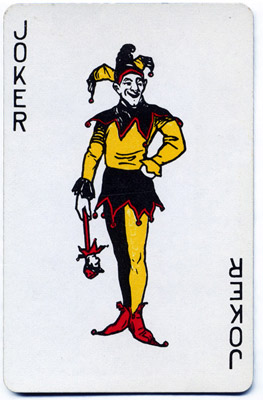


Of course, the "Jokers" both stand outside of this system and are related to it.[11]

As "coincidence" would have it, as I sit typing these notes, Infowars commentators Paul Joseph Watson posted the following to his Facebook account:

"The delusion of 'happiness' is dependent on an ever growing detachment from reality."[12]


It puts me in mind of the much-repeated, but less-analyzed phrase, the "American dream." The Online Etymology Dictionary reports:

"‘American dream’ ...coined 1931 by James Truslow Adams (1878-1949), U.S. writer and popular historian (unrelated to the Massachusetts Adamses), in 'Epic of America.' '[The American Dream is] that dream of a land in which life should be better and richer and fuller for everyone, with opportunity for each according to ability or achievement. It is a difficult dream for the European upper classes to interpret adequately, and too many of us ourselves have grown weary and mistrustful of it. It is not a dream of motor cars and high wages merely, but a dream of social order in which each man and each woman shall be able to attain to the fullest stature of which they are innately capable, and be recognized by others for what they are, regardless of the fortuitous circumstances of birth or position.' [Adams] Others have used the term as they will."[13]

To many Americans, the "American dream" probably did (or maybe does) designate "...the dream of being a blue-collar manufacturer living, in a suburban house with a white picket fence, with your wife and two kids."[14]

Maybe this "dream" has a shadow-side - to be distracted with "fast-food" and "professional sports," in an updated version of Juvenal's "bread and circuses.”[15] Or perhaps it's entirely shadow-play - a mockery of the sleeping "masses," sustained by illusion. They get their "news" from the same corporate-owned media that make Transformers look real and (in Noam Chomsky's words) "sell us toothpaste." In fantasy-land, the ephemeral lottery ticket symbolizes the chance that the "average Joe" will make it big. One recent count puts your odds at "one in 175 million" - give or take 220,000.[16]

"Mr. Sand-man ...bring me a dream."[17]


It's Hil[l]ar[y]ous.[18]

"Medieval English form of Hilarius or Hilaria. During the Middle Ages it was primarily a masculine name. It was revived in Britain at the beginning of the 20th century as a predominantly feminine name. In America, this name and the variant Hillary seemed to drop in popularity after Hillary Clinton (1947-) became the first lady."[19]

Notes:


[1] Steve Winkler, Jul. 7, 2015, <http://www.theguardian.com/commentisfree/2015/jul/07/why-do-so-many-democrats-support-bernie-sanders>.

[2] "Sandman," Wikipedia, Sept. 27, 2015, <https://en.wikipedia.org/wiki/Sandman>.

[3] Noam Chomsky, "Rollback," Z Magazine, Jan.-May, 1995, <http://chomsky.info/199505__/>; cf. Gabrielle Dunkley, "Noam Chomsky: Obama Would Have Been A 'Moderate Republican' Several Decades Ago," Huffington Post, Feb. 1, 2013, <http://www.huffingtonpost.com/2013/02/01/noam-chomsky-obama_n_2599622.html>.

[4] "The Sandman," in Nachtstücke ["Night Pieces"], Berlin: n.p., 1817.

[5] Eventyr, fortalte for Børn ("Fairy Tales Told for Children)", 3rd ed., Copenhagen: C. A. Reitzel, 1842.

[6] Columbia, 2007.

[7] Douglas Harper, "Trump," Online Etymology Dictionary, <http://www.etymonline.com/index.php?term=trump>.

[8] Elizabeth Boyd, Popular arts of Spanish New Mexico, Santa Fe, N.M.: Museum of New Mexico Press, 1974, p. 463; archived online at <https://books.google.com/books?id=U71aAAAAMAAJ>.

[9] Cavendish [pseud. of Henry Jones], "Historical Notes on Our National Card Game," London Society, vol. 9, London: William Clowes and Sons, 1866, p. 66; archived online at <https://books.google.com/books?id=pBpLAQAAMAAJ&pg=PA66>.

[10] Arthur Edward Waite, The Mysteries of Magic, London: Kegan Paul, Trench, Trubner and Co., 1897, p. 184; archived online at <https://books.google.com/books?id=RLZQvfyrwtwC&pg=PA284>.

[11] See also "Veritas Vincit", "Joker Copycats", "Victor Hugo, The Joker, Joker Copycats," and "Hue of Lincoln".

[12] Paul Joseph Watson, post, Facebook, Oct. 11, 2015, <https://www.facebook.com/paul.j.watson.71/posts/10153714911016171>.

[13] Douglas Harper, "American Dream," 2015, <http://www.etymonline.com/index.php?term=American+dream>.

[14] "American Dream," Urban Dictionary, Apr. 18, 2006, <http://www.urbandictionary.com/define.php?term=american+dream&defid=1705731>.

[15] Panem et circenses, Satires, book 10.

[16] Ronald L. Wasserstein, "A Statistician's View: What Are Your Chances of Winning the Powerball Lottery?" Huffington Post, May 16, 2013, updated, Jul. 16, 2013, <http://www.huffingtonpost.com/ronald-l-wasserstein/chances-of-winning-powerball-lottery_b_3288129.html>.

[17] Francis Drake "Pat" Ballard, "Mr. Sandman," recorded by The Chordettes, Cadence, 1954.

[18] From Latin hilarius, (“cheerful”)…. "Hilarious," Wiktionary, <https://en.wiktionary.org/wiki/hilarious>.

[19] "Hilary," Behind the Name, <http://www.behindthename.com/name/hilary>.

Friday, October 12, 2012

Laugh


"The common defect of all mystical systems previous to that of the Aeon 
whose Law is Thelema 
is that there has been no place for Laughter." 
~ Aleister Crowley , "Laughter," Little Essays Towards Truth
(Source)

"And there is no Vision more critical in the career of the Adept of Horus than the Universal Joke. ... In the idea of Laughter is inherent that of Cruelty... Nature is full of cruelty; its highest points of joy and victory are marked by laughter." (Source) On "nature's cruel laughter" see Loren Coleman's piece on Hurricane Isaac (among other things): "Isaac Laughs." Additionally, 23 years ago the power Category 5 Hurricane Hugo made "[l]andfall in South Carolina ...at midnight on the night of the 21st" of September, 1989.

"For [U.S. Vice President Joe] Biden and [Representative Paul] Ryan, debate becomes a laughing matter". Stewart and ("Lincoln-Killing") O'Reilly paved the way. The "real" debate is mocking the mockery, I suppose. Of the "debate," O'Reilly is supposed to have stated: "[Y]ou wouldn't see this in a lot of other countries. That's for sure." (Source) Well, even a broken clock is right twice a day. (Cf.: 1, 2, 3, 4, 5, 6, 7, & 8) It's a palimpsest of mockery. "As the mountebank delivered his harangue, the clown would repeatedly poke his head out from behind the curtain, making fun of everything his master said, parodying his patter and twisting the meaning of his words. The mountebank played the perfect straight man, meanwhile. Here he was, trying so hard to hawk his wares, and his own assistant was doing everything possible to undermine sales. The merriment was of course intentional. While the clown seemingly encouraged the public not to buy the proffered merchandise, the mountebank knew full well that the bystanders would easily be converted into customers as soon as they forgot that they were, in fact, supposed to be buying. Once the audience had been effectively hypnotized, once its judgment and willpower had been weakened, the real sales pitch could begin..." (J.H. Towsen, Clowns; qtd. in Hoffman, Secret Societies and Psychological Warfare, p. 18).
(Source)
This jesting at the jest has been called the risus purus - the "pure laughter." "The highest form of laughter (the "risus purus" Beckett calls it in his early novel Watt) is the laughter about human unhappiness." (Source)
(It's risible)

Risu!: "Ay! let us end with that most sudden surprising Word of a certain Angel of The Vision and the Voice, who left the Seer lapsed in his solemn Trance with the gay laughing phrase—"But I go dancing!" The Tables of the Law? Bah! Solvuntur tabulae—risu!" (Crowley, op. cit.)

Note, in the above Beckett quotation that the "risus purus" is connected with the word "dianoetic." The root word "noetic" has to do with Reason - that is, the rational faculties - and is derived from the word "nous" ("mind"). "Dia" is a Greek preposition that means "through" or "by means of." For his "Dianetics," Hubbard apparently just dropped the mind and substituted a net. "THE ONLY WAY YOU CAN CONTROL PEOPLE IS TO LIE TO THEM. You can write that down in your book in great big letters. The only way you can control anybody is to lie to them." (L. Ron Hubbard) In this way, Hubbard was a bit ahead of his time. For nowadays most of us seem to get our information dia-net - through the "net" or "world wide web." Or, as Hoffman has put it, we're "wired to the data hive" (op. cit.).

"The core of the reactive mind is called the bank. It may surprise you to learn that the bank consists of word-phrases called GPMs (Goals-Problems-Mass) placed there to confuse..." (Source) "The 'Laughter-Calm' GPM, or implant, is described as having taken place 19,670 trillion years ago[:] 'This takes place in a cave. It is 7-1/8ths of a second in duration. It has screams of laughter, very wild, and calm....It is a pole with a split in it. Laughter comes from the rear half and calm from the front half simultaneously. Then they reverse. It gives one a sensation of total disagreement. The trick is to conceive of both at the same time. This tends to knock one out....'" (Source)


(It's Rise-able)

MoveOn comments: "Phew! Last night, Joe Biden kicked butt and may have put the brakes on Mitt Romney's rise." (Anna Galland, MoveOn.org, Email, Friday, October 12, 2012 2:54 PM)

Tarot: "De Mercurio...The sense of humour of this god is very strong. He is not sentimental about his principal function; he regards the Universe as an excellent practical joke; yet he recognizes that Jupiter is serious, and the Universe is serious, although he laughs at them for being serious. ...THE LORD OF ILLUSION..." (Aleister Crowley, The Book of Thoth, p. 128.)
(Source)
(Source)
(Source; "Glenn Beck Calls Himself a ‘Rodeo Clown’")

"Indeed the human face when crying can seem very close if not identical to that same face laughing."
(Source: Michael Taussig, "The Language of Flowers," Critical Inquiry, Vol. 30, No. 1 [Autumn 2003], p. 98.)
(Source)

[Update 16 October 2012]

Pre-Halloween Candy 
(Candy Alt Crowley; Photo Source)

"Presidential debate moderators announced: Crowley is first woman in 20 years ...The 2012 presidential debates will feature a female moderator for the first time in 20 years. The Presidential Debate Commission announced Monday that PBS’s Jim Lehrer, CBS’s Bob Schieffer and CNN’s Candy Crowley will moderate the three presidential debates, while ABC’s Martha Raddatz will moderate the lone vice presidential debate between Vice President Biden and Rep. Paul Ryan (R-Wis.). Crowley is the first female moderator for a presidential debate since ABC’s Carole Simpson, who was the last female to land the gig in 1992." (Source) See also the Lewis Carroll-like "Alice"-reference, below.

(Source)
(Say it crow-ly; Photo Source)

"CNN’s Candy Crowley recently called Mitt Romney and Paul Ryan the 'death wish ticket.'" (Source) CNN's Candy Crowley claimed some Republicans think this 'looks a little bit like some sort of ticket death wish.'" (Source) "CROWLEY: ...looks a little bit like some sort of ticket death wish." (Source)
(Source)

"...as though Kennedy would be alive today if you'd been in bed at 10:00 p.m. That's ludicrous. ... You wanted to station agents on his bumpers and side boards. He refused. Do you know why I think he refused? I think he refused because he had a death wish. He talked all the time about being assassinated. His favorite poem was 'I Have a Rendezvous with Death'... which is not a good poem, Frank. I think he wanted to die. ..." ~ John Malkovich as assassin Mitch Leary, Calling Clint Eastwood as Agent Frank Horrigan, from "Lafayette Park," Movie: "In the Line of Fire". On "Lafayette", see here (the post includes numerous links to several now classic articles on the "Fayette Factor").
("Go ask Alice, I think she'll know" ~ Jefferson Airplane, "White Rabbit"; Photo Source)

"Malkovich, who leaves a trail of bodies as he stalks the president, likes to tantalize Eastwood by phone with new riddles, threats and pearls of wisdom." (Source) Candy Crowley ("In an interview with CNN..."): "They will call on 'Alice,' and 'Alice' will stand up and ask a question. Both candidates will answer. Then there's time for a follow-up question, facilitating a discussion, whatever you want to call it,' Crowley said. 'So if Alice asks oranges, and someone answers apples, there's the time to go, 'But Alice asked oranges? What's the answer to that?' Or, 'Well, you say this, but what about that?'" (Source)
(Source)

Speaking of "In the Line of Fire," who was it recently making cryptic throat-cutting motions at the Republic Convention? Read about it HERE.
(Source)

As Jim Brandon pointed out years ago in "Sirius Rising," JFK was reported to have read a book called The King Must Die. "As a child, Jack Kennedy would 'devour [stories of] the knights of the Round Table,' according to Jackie. After the Wisconsin primary during the 1960 election campaign, he read The King Must Die, by Mary Renault, about the martyrdom of such folk heroes as Arthur in Britain and Roland in France." (Source)
(Source)
(Orange grove; Source)

For more, see HERE.
###

Sunday, August 26, 2012

"Armstrong" (Symbolically-Ostensively Defined)

Top headline for Saturday, August 25, 2012:

"Space legend Neil Armstrong dies"

The word "legend" has just been in the news over the last few days, interestingly connected to both the "Empire State Shooter" and the suicide of Tony Scott. (See, for example, Loren Coleman's post.)

But, let's look at the word "armstrong." In the first place, "Armstrong" is the name of a Scottish clan.
 
"The Armstrongs (sword strong arm) were a powerful Border family who may have descended from Siward Digry, the last Anglo-Danish Earl of Northumberland. Traditionally though the Armstrongs claim descent from Fairbairn, armour bearer to a Scottish king, who rescued his monarch in the midst of battle. The family came to be known as "Armstrong" and received lands in Liddesdale." Source

(The Armstrong clan "seat" is said to be "The Hollows." I have discovered that "The Hollows" also designates a television sci-fi mystery series (with advance apologies to fans because of my minimalist summary) that centers around witches and is premised on the "...the historical investment of Cold War military spending in genetic engineering as opposed to the Space Race...". As William Grimstad once commented, Scotland is very deeply associated with witchcraft. Another US-Scotish-Witchcraft connection is the so-called "Bell Witch.")

The Armstrong clan's motto has been described as follows: "The Armstrong Family Motto appears in several forms, most commonly as Invictus maneo (I remain unvanquished) The complete motto is Vi et armis invictus maneo (Through/by the force of arms I remain unconquered)." This motto might remind one of the poem "Invictus" by William Ernest Henley which, as was reported by Michael Hoffman in his Revisionist History #19 (Summer 2001), was used by Timothy McVeigh as his final statement.

There is a "Scottish Rite" of Freemasonry. And there is a straightforward connection between NASA's Apollo missions and Freemasonry, as Loren Coleman points out. The Scottish Rite has likewise been mentioned recently in association with Tony Scott. (See, e.g., VISUP.)

There is also an "Armstrong Gun." Apparently, it's sort of shaped like a telescope (from "tele-" meaning "distant, far" and "skopeo" or "I look") which is, of course, a tool used (among other things) to make astronomical observations.


"The Armstrong was a large rifled cannon invented by an Englishman, Sir William George Armstrong, in 1854. It's most noticeable feature was the series of graduated coils over a lengthwise tube, causing it to look like a giant collapsible telescope pulled out in overlapping circles. ..." Source

So then we have "Armstrong" in the news during what has been termed "The Summer of the Gun," about which Loren Coleman has written.

Now James Shelby Downard pointed out that Jules Verne anticipated the "rocket trip to the moon" around one hundred years. Since "...Hecate ...[is] the goddess of witchcraft in Greek mythology, but ... hekaton is Greek for 'hundred'," we could say that Jules Verne preceded NASA by a Hecate (we'll have more to say about Hecate elsewhere). In 1865, Jules Verne wrote a story entitled "From the Earth to the Moon." In this story, which includes several references to "Armstrong" and the "Armstrong cannon," gun manufacturers construct a gigantic "Moon Gun" which they use to shoot three astronauts at the Moon.

As a sidebar, and apropos of "The Summer of the Gun" thread, Jules Verne also wrote a story entitled Dr. Ox's Experiment or A Fantasy of Dr Ox in which "A prosperous scientist" - Dr. Ox - conducts a hidden ("occult") "large scale experiment on effect of oxygen on plants, animals and humans. ...causing accelerated growth of plants, excitement and aggressiveness in animals and humans." Fantasy is given as "'illusory appearance,' from O.Fr. fantaisie (14c.) 'vision, imagination,' from L. phantasia, from Gk. phantasia 'appearance, image, perception, imagination,' from phantazesthai 'picture to oneself,' from phantos 'visible,' from phainesthai 'appear,' in late Greek 'to imagine, have visions,' related to phaos, phos 'light,' phainein 'to show, to bring to light' (see phantasm). Sense of 'whimsical notion, illusion' is pre-1400, followed by that of 'imagination,' which is first attested 1530s. Sense of 'day-dream based on desires' is from 1926."

This connection to "light" (phos, photos) is reminiscent of Phanes and the so-called "Orphic Egg" or "Cosmic Egg" which I wrote about in conjunction with Aurora and the Olympic Games (Athena-Nike). Interestingly, that writing also mentions Prometheus - the Pyrphoros ("fire-bringer"). Of course, Ridley and the recently deceased Tony Scott released a movie by that name earlier this year, which movie banner I displayed 5 weeks ago.

"Fantasy" is related, therefore, to the Latin video which can designate "seeing" or "seeming" depending upon whether it is used actively or passively. Of course, a cognate of video is present in the word "television" ("to see distantly" or, perhaps, "to seem distantly") which has been said to have a "hypnotic" or "mesmerizing" effect on people, possibly due to the television operates via "beams of light being fired at the viewer at a high rate". I believe that Marshall McLuhan suggested that moving-light-pictures could have a hypnotic effect, or not, depending on whether the viewer sat passively while the light was beamed at her face (as in television) or whether the light was beamed onto a screen (as in a theater). The American people were shown the Apollo-Artemis ritual via television. But there was an interesting technical difficulty. As David McGowan quotes Reuters: "Because NASA’s equipment was not compatible with TV technology of the day, the original transmissions had to be displayed on a monitor and re-shot by a TV camera for broadcast."


About Jules Verne it has been said that: "...some travelers' stories he wrote for the Musée des familles revealed his true talent: describing delightfully extravagant voyages and adventures with cleverly prepared scientific and geographical details that lent an air of verisimilitude."

Perhaps I can interject bits such as that Noam Chomsky has characterized the "the Pentagon system" as "including the Department of Energy (which produces nuclear weapons) and NASA"; and maybe I should remind readers of things such as that CBS founder William Paley "...served in the psychological warfare branch in the Office of War Information, under General Dwight Eisenhower...[d]uring World War II...". "Richard Salant, president of CBS News at the time, called Apollo 11, '...one of television’s greatest achievements.'" Source Salant is also reputed to have said: "Our job is to give people not what they want, but what we decide they ought to have."

In any case, Verne is thought of as a "Science-Fiction Prophet": "[Jules Verne] put a man on the Moon in the Victorian Era. ... When Neil Armstrong set foot on the Moon in 1969, he credited Jules Verne with inspiring the mission over a century earlier. In From the Earth to the Moon, Jules Verne not only [prophesied] that man would walk on the lunar surface, he outlined exactly how to do it...from a Florida launch pad to a Pacific Ocean splash down."

NASA writes: "Jules Verne's 1865 science fiction novel 'From the Earth to the Moon' inspired rocketry pioneers like Robert Goddard and Konstantin Tsiolovsky to work out the real mathematics and engineering of space flight. One-hundred-and-four years later, American astronauts Neil Armstrong and Buzz Aldrin became the first human beings to walk on the Moon."

"This illustration from one edition of the book shows passengers in Verne's space ship - fired to the Moon from a giant cannon on Earth - enjoying their first taste of weightlessness." (Ibid.)

"A hundred years ago, Jules Verne wrote a book about a voyage to the Moon. His spaceship, Columbia, took off from Florida and landed in the Pacific Ocean after completing a trip to the Moon. It seems appropriate to us to share with you some of the reflections of the crew as the modern-day Columbia completes its rendezvous with the planet Earth and the same Pacific Ocean tomorrow." ~ Neil Armstrong, [23] July 1969

In Verne's book there were three people shot at the Moon. Encyclopedia Astronautica comments:

"The circumlunar spacecraft would have a crew of three. The names of the crew were Ardan, Barbicane, and Nicholl (Anders, Borman and Lovell on Apollo 8; Aldrin, Armstrong, Collins on Apollo 11)." (And Verne's story has other parallels to NASA's story. Additionally, last year Buzz Aldrin was in the news regarding a divorce to his third wife of 23 years. Her maiden name is Cannon.)

In general, "The Moon is 'the goddess with three forms': Selene in the sky, Artemis on Earth, and Hecate in the lower world, the world above cloaked in darkness. The Moon’s phases reflect these forms. As the new Moon she is the maiden-goddess Artemis, always new and virginal, reborn and ready for the hunt. As the waxing Moon, increasing in fullness, she is the fertile mother-goddess, pregnant with life. And as she wanes to darkness, she is the wise crone or witch Hecate, knowing the magical arts, with the power to heal or transform." Now Hecate/Hekate is sometimes called the "Triple-Goddess" (Trivia) and she is both a Moon-goddess and a witch-queen: "(Greek mythology) The goddess of the night and crossroads, usually associated with witchcraft and sorcery, as well as ghosts and childbirth. Said to reside in Hades."

The Online Etymology Dictionary associates Hecate and Artemis and gives one of the meanings of "Hecate" as: "hekatos 'far-shooting.'"

In Book XI of Virgil's Aeneid we read about King Metabus, the father of the Warrior-Princess, Camilla. In summary: "Driven from his throne, Metabus and his infant daughter Camilla were chased into the wilderness by armed Volsci. When the river Amasenus blocked his path, he bound her to a spear and promised Diana that Camilla would be her servant if she would safely transported to the opposite bank. He then safely threw her to the other side, and swam across to retrieve her." 


In John Dryden's translation: "A knotty lance of well-boil'd oak he bore | The middle part with cork he cover'd o'er | He clos'd the child within the hollow space | With twigs of bending osier bound the case | Then pois'd the spear, heavy with human weight | And thus invok'd my favor for the freight |'Accept, great goddess of the woods,' he said | 'Sent by her sire, this dedicated maid! | Thro' air she flies a suppliant to thy shrine |And the first weapons that she knows, are thine.' | He said; and with full force the spear he threw | Above the sounding waves Camilla flew. | Then, press'd by foes, he stemm'd the stormy tide | And gain'd, by stress of arms, the farther side."

We see a girl, dedicated to the Moon-Goddes Diana (Artemis) being enclosed "with the hollow space," tied to a spear, and thrown across a flooded, raging river "by stress of arms" or, as we might put it alternatively, by strength of arm - by Armstrong!

(Humorously: "The Moon Pie became a traditional 'throw' (an item thrown from a parade float into the crowd) of Mardi Gras "krewes" (parade participants) in Mobile, Alabama during 1956, ... followed by other communities along the Mississippi Gulf Coast." Source)

Jules Verne's Moon Gun is called the "Columbiad." Michael Hoffman has written that: "The occult name for America is Columbia." Columbia is related to "Columbine" which Hoffman gives as: "...the cutting of America" (Loc. cit.). Of course the "Dark Knight of Aurora" or "Batman Shooter" has parallels with the Columbine Massacre. And both shootings have occult associations with the "Fool" Tarot card (or so I have speculated). Jules Verne's "From the Earth to the Moon" was adapted into a comedy in the UK in 1967. It was variously titled "Jules Verne's Rocket Trip to the Moon," "Blast Off!" and "Those Fantastic Flying Fools."

Artemis, sometimes identified with Hecate (as stated), as well as Luna, Diana, Selene, et. al., was a "Greek goddess of the moon, wild animals, hunting, childbirth, etc.; sister of Apollo; her name is of unknown origin."

However Robert Graves, in The Greek Myths, acknowledges that "The meaning of Artemis is doubtful" but he opines that: "...it may be 'strong-limbed', from artemes; or 'she who cuts up', since the Spartans called her Artamis, from artao' or 'the lofty convener', from airo and themis; or the 'therais' syllable may mean 'water', because the moon was regarded as the source of all water."

"Strong-limbed" is arguably very close to something like Armstrong. And "she who cuts up" would link Artemis to Columbine ("America-cutter").

Graves also associates Artemis with the sacred-king and says that "...'Artemis' [is] one more title of the Triple Moon-goddess; and had a right therefore to feed her hinds on trefoil, a symbol of trinity. Her silver bow stood for the new moon. Yet the Olympian Artemis was more than a Maiden. Elsewhere, at Ephesus, for instance, she was worshipped in her second person, as Nymph, an orgiastic Aphrodite with a male consort ..." This "orgiastic" aspect relates to the sexually-charged "Dog Days" of Summer ritualism, as VISUP mentions. (See also here.)

In any case, Arthur Waite associates the Moon with "...Hidden enemies, danger, calumny, darkness, terror, deception, occult forces, error. Reversed: Instability, inconstancy, silence, lesser degrees of deception and error." Waite's judgment, here, may have partially to do with the fact that the mythological Gorgons who were "representatives of the Triple-goddess, [and wore] prophylactic masks with scowl, glaring eyes, and protruding tongue between bared teeth [in order] to frighten strangers from [the Moon goddess's] Mysteries." (Graves, op. cit.) Graves adds: "The Gorgons’ names—Stheino (‘strong’), Euryale (‘wide roaming’), and Medusa (‘cunning one’)—are titles of the Moon-goddess; the Orphics called the moon’s face ‘the Gorgon’s head’." (Ibid. "Alcmene (‘strong in wrath’) is another Moon-title.")

The Moon is also linked to water, and we're emerging from a drought (in Alchemy, there are two methods for creating the Philosopher's Stone, the Wet-Method and the Dry-Method. See here.) Graves: "Haliartus, where he had a hero-shrine, was apparently sacred to the ‘White Goddess of Bread’, namely Demeter, for Halia, ‘of the sea’, was a title of the Moon as Leucothea, ‘the White Goddess’ (Diodorus Siculus), and artos means ‘bread’."

And Waite connects this water to the deep-psyche with its animal impulses, perhaps like those exacerbated by Dr. Ox or The Summer of the Gun: The Moon "...illuminates our animal nature, types of which are represented below—the dog, the wolf and that which comes up out of the deeps, the nameless and hideous tendency which is lower than the savage beast. It strives to attain manifestation, symbolized by crawling from the abyss of water to the land, but as a rule it sinks back whence it came."

These sorts of symbol-patterns are always confusing.

"Confuse" (def.) "...as Latin confusus was the pp. of confundere 'to pour together, mix, mingle; to join together;' hence, figuratively, 'to throw into disorder; to trouble, disturb, upset.' ..."

 Such a pattern is as rare as a blue moon.