Matthew J. Bellwith Jim Brandonauthor of Weird America and The Rebirth of Pan
“[T]he blowing up of the first meridian is bound to raise a howl of execration.”- Joseph Conrad, The Secret Agent[1]
In the previous post, In Tenebris, we took on the topic of the layers of symbolism enveloping the City of London world financial center. Our treatment was occasioned by a fictional terrorist bombing there – perhaps near the intensely occultic Knights Templar church – as depicted in the new blockbuster movie, Star Trek Into Darkness (“Into Darkness”).
We now propose to explore further into – and in a moment, farther southeast of – this lurid Londoniana. Our primary setting will shift to Greenwich [2] (from the “...Old English Grenewic ...literally ‘Green Harbor’.”),[3] where so-called “Universal Time” is officially based. “Time and space are measured from [Greenwich]” in the astute words of the unusual group called the London psychogeographers.[4]
This modern function is nevertheless in keeping with an ancient tradition, it seems. For “Greenwich was once an area of great sacred importance...” in the view of the insightful Aquarian Guide to Legandary London.[5] So, if science and its handmaiden technology have become the de-facto religion of the day, this area must be a veritable Vatican or Mecca. How the Greenwich conversion from the mythic or folkloric to the highly technical was made, at a critical turning point of European culture, will soon be told.


As we noted in part one, the Prime Meridian of longitude was established at Greenwich “by high adepts of alchemy and occult orders.” Their starting point? The ominously portentous Tower of London, reputed site of the ancient British palladium of power, the buried head of the Celtic king, Bran. From the Tower precincts the adepts measured in English miles, to four decimal places, a number that is generated by every school child studying simple geometry and the ratio of the circumferance of a circle to its diameter. In short, pi: or 3.1416 miles due east to the new meridian at Greenwich.
That at least was the claim of a little-known Scottish geometry savant, Hamish MacHuisdean, whose unusual work coauthor Jim Brandon discovered by chance years ago. In a moment, we will be taking a close look at the chief MacH. contentions that the pi constant is discrete at 3.1416 and not an irrational or infinitely recurring decimal – and that the 31416 “series” is the secret derivation of 33, the master Mason degree.
All this and the Kabbalah, too. We will consider the tantalizing indications of a cryptic rôle played by the formidable Jewish esoteric complex in these undertakings of the British maguses.
Traditional Aspects of Time


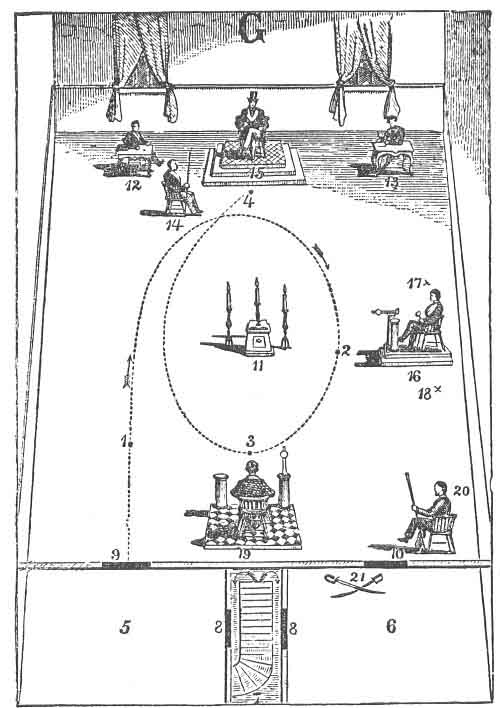
For now, since “Time is of the essence” at Greenwich, we need to lay groundwork. Time, considered as a deity, is both “[t]he Creator and Devourer. ...it is... the revealer of Truth.”[12] Midway between the poles of creation and destruction is the vast middle ground over which operates a maintaining or sustaining force that keeps the present order. Hence, “In all the ancient mythologies there were triads...a creator, a preserver, and a destroyer. ...[In the heathen system of] the Indian, Brahma, Vishnu, and Siva... This system of triads... has become... in Freemasonry... the triad of three governing officers... [t]he Master and the two Wardens... We must...look for the origin of the triads... to the three positions and functions of the sun. The rising sun or creator of light, the meridian sun or its preserver, and the setting sun or its destroyer...”.[13]
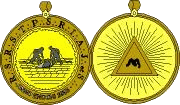
To the Freemason, “Time ...is ...the symbol of well-directed perseverance in the performance of duty.”[16] And the “great object of a Freemason’s labor” is to “at last obtain the true Word which is the symbol of Divine Truth.”[17] The “true Word” was, according to Freemasonic legend, rediscovered “...at the hour of meridian...”.[18] Importantly, “[t]he cessation of time is the break-through to enlightenment; eternity.”[19]
This complex tissue of subtle symbolism was not lost on famed novelist, Joseph Conrad. His story, The Secret Agent, depicts an attempted bombing “...attack on the Greenwich meridian...”, which target represents “...a displaced attack on the empire...”.[20] Conrad explicitly describes the plot to detonate a bomb at the prime meridian in terms of “...rendering of cosmic chaos...”.[21] However, it is not simply the return to chaos – as the Joker-character seemingly wants, as an “agent of chaos” [22] in The Dark Knight Batman movie (2008). [23] Rather, what is in view is a combination of “chaos and eternity,” [24] exactly along the symbolical lines one would expect from a plot, not simply to blow up a landmark, but to control or harness the occult power of Time (Cronos/Saturn [25]) itself. [26] Although not about Greenwich, specifically, the reader may find it useful to ponder the comment of award winning English author (and psycho-geographer), Peter Ackroyd: “There are parts of London where time has actually hardened and come to an end.” [27]
Actual Terrorism Near Greenwich
Our present study is not merely concerned with thriller novels or science fiction movies, however. Within the last few weeks, the United Kingdom experienced its first terrorist attack since the 7/7 Bombing of 2005, when a British soldier (with duties in the Tower of London) was hacked to death at 2:20pm, Greenwich-time, on a street in the district of Woolwich. Woolwich is now “located in the Royal Borough of Greenwich.”[28]
About the selection of the attack location, journalist Andrew Gilligan writes the following.
“The site of Wednesday’s attack was not random, nor in all probability was it chosen simply because there was a barracks nearby. Woolwich, as not many people seem to have realised, is one of the cradles of al-Muhajiroun. ...Woolwich is at the join of yet another extremist-related ley line. It is not just a major military garrison; it is not just one of the spawning-grounds of al-Muhajiroun; it is also, of course, home to the main Category-A prison where accused terrorists are held, and the main court, attached to it for security reasons, where terrorist trials take place.”[29]
Despite the fact that Gilligan’s use of the phrase “ley line” arguably is merely artistic, it nevertheless brings the idea of mystical alignments into the public arena.
Also worthy of mention is a so-called “...French plot to change the way we tell the time...”.[30] This might be thought nothing more than a foofaraw, were it not for the the potent symbols swirling around Greenwich as well as the fact that this dispute over time-keeping must be set against the historic dispute over longitude-determination. “The French clung to the Paris meridian as a rival to Greenwich until 1911 for timekeeping purposes and 1914 for navigation. To this day, French cartographers continue to indicate the Paris meridian on some maps.” [31] And it may be recalled that a representation of this line, inlaid in the floor of an important Paris church, was shown in the recent film, The DaVinci Code.


But we are getting ahead of ourselves. Let us back up and consider Into Darkness. As previously noted, the main villain in this latest Star Trek is Khan. But Khan is introduced under the alias John Harrison. “John Harrison” also names a historical personage, in this case, the man remembered for having solved the “longitude problem.” (Incidentally, this study was also a part-time occupation of Emmanuel Swedenborg. See HERE.)
The “longitude problem” is simply a label for the difficulty, in an era predating satellites and fancy techno-gadgetry, of determining one’s longitude on the open sea. It turns out that every 15 degree movement – due east or west – has the effect of adding or subtracting one hour from one’s local time. Hence, if one can compare one’s local time, which local time can be gleaned from the position of the sun, to a reference time at a location with a known longitude, one can calculate the longitude of one’s current position. [32]
Siting the Meridian Line
Greenwich, England was selected for the longitude reference position. Towards this end, a project was begun – involving alchemist and physicist, Isaac Newton – to establish a line of 0 degrees longitude, running through Greenwich. [33]

(Image source: MacHuisdean, The Great Law, p. 86, figure 15.)

(Image source: MacHuisdean, op. cit., p. 47.)
How was this done? We wouldn’t have had a clue, except that, as we noted at the outset, a Scottish geometer and arithmetician named MacHuisdean (MacH for short) had published in the 1920s and ‘30s a curious and offbeat book that he called The Great Law. [34] When Jim Brandon, by sheer chance, found a copy of this in the amazing old Atlantis Bookstore on Hollywood Boulevard in Los Angeles years ago, he immediately saw its value in relation to the Prime Meridian. This imaginary but world-historically-important symbol construct had piqued his curiosity since reading Joseph Conrad’s The Secret Agent as a kid.
Quite discursive in nature, MacH’s book will quickly be found to have a fascination if not a monomania for the pi factor, citing a vast number of instances in which 3.1416 or variants up to 31416 recur in sites of geodetic interest to the author. These are primarily around the British Isles and by far the most important is the one shown above, asserting the pi-miles distance from the Tower of London’s adjunct Salt Tower to zero Greenwich. MacH tosses off this highly significant finding tersely, only citing “the Ordnance Survey Office in Southhampton” as his source and offering no insights on why or by whom the mileage was selected. [35]
Verifying these claims has turned out to be a major work in progress, since what MacH seems to be talking about must be maps published three-quarters of a century ago by the British agency in question but locating them now in this country has not been fruitful. Also, the distance given by the Google mapping service from Salt Tower to Greenwich varies slightly depending upon where one places the ruler points. However, from the (“eye-balled”) center of the Salt Tower to roughly the center of “Prime Meridian Walk,” is 3.16019 miles, by our quick-and-dirty Google calculation.

(Image source: Google Maps.)
One can obtain MacH’s pi-distance by placing the first ruler point on the easternmost edge of the Salt Tower. However, one ends up slightly to the west of “Prime Meridian Walk.” Perhaps the street name is a misnomer.
(Image source: Google Maps.)
In resolving this discrepancy there are several possibilities. 1 – MacH correctly read his Ordnance map which was itself correct, but the current Google distance is wrong. 2 – MacH was correct reading the map but the map itself was wrong, and Google is right. 3 – Google is right and MacH, by error or (heaven forbid!) design, misrepresented the map which had no pi distance and substituted his favorite number. 4 – MacH correctly read his Ordnance map, which was itself correct, but the Google distance calculations are at variance with MacH because the relevant measurements are sensitive to the exact exact trajectory line MacH used, and this line is unknown to us. However, to round out our last possibility, we may suppose that were MacH’s trajectory lines known, Google would confirm MacH’s distance computations.
So, considering all of that and on the offchance that there really was a “pi distance” plotted out by God knows whom for this key geodetic link-up of the Tower palladium to the Greenwich node for time and space – and just imagine what psycho-geo novelist Peter Ackroyd could do with that image of the King Bran head still ritually venerated in a crypt under the Tower – we will examine 3.1416 a bit further. Surprisingly, this will involve a major Kabbalah connection, bringing in that high-voltage Jewish mystical aspect, which was certainly in the air at the time of Isaac Newton and the Royal Society clique and nascent Freemasonry in the late 1600s.
The Kabbalah will be found to embody the pi factor as a coordinate regulating the spatial aspects of creation. As this will be a considerable side trip from our present topic, however, we must consign that account – plus some further aspects of the seat-of-the-pants kabbalism of Hamish MacHuisdean – to the notes. But the fundamental point to remember is that it is entirely possible that the Prime Meridian may have been placed according to kabbalistic principles. [36],[37]
The Greenwich Royal Observatory was established for the purpose of precisifying moon observation data, one step on the road to making possible longitude determination at sea. [38]
“King Charles II founded the Royal Observatory in 1675 to solve the problem of finding longitude at sea. If an accurate catalogue of the positions of the stars could be made, and the position of the Moon then measured accurately relative to the stars, the Moon’s motion could be used as a natural clock to calculate Greenwich Time. Sailors at sea could measure the Moon’s position relative to bright stars and use tables of the Moon’s position, compiled at the Royal Observatory, to calculate the time at Greenwich. This means of finding Longitude was known as the ‘Lunar Distance Method’.” [39]
We encountered King Charles II previously. He is the monarch who provided for ravens to populate, in perpetuity, the grounds in front of the White Tower. He also established, in 1660, the Royal Society of London. Authors Michael Baigent and Richard Leigh note that “Charles II was deeply interested in alchemy...”. [40]

John Harrison, also the name of a chief protagonist in the recent movie, Star Trek Into Darkness, provided another piece of the puzzle. He invented a clock (the marine chronometer) that would keep fairly accurate time, despite the disrupting motion of ocean waves.


The fascination with time is echoed in Into Darkness. In the movie, the home planet of the Klingon race “...is both spelt and spoken as Kronos”. [45] “KRONOS (or Cronus) was the Titan god of time and the ages...”. [46] He is identified with the Roman deity Saturn.


We already reported the prominence, in the film, of the mystical number 72. It may not shock the reader to learn, therefore, that 72 has mythological ties to both Kronos and the moon. “Thoth, in an Egyptian creation myth, wins a 72nd of each day of the year from the Moon in a game of draughts, as a favour to Nut, the Sky Goddess. He uses these portions to make the five intercalary days on which the remaining Gods and Goddesses are born.” [47] “The god Kronos (Geb) and the goddess Rhea (Nut) had illicit intercourse. Helios (the sun god) tried to prevent Rhea from giving birth at any time in the year. However, Hermes (Thoth) managed to add five days to the year by beating the moon in a game of draughts. These became the birthdays of five deities - Osiris, Apollo (Horus the Elder), Typhon (Seth), Isis and Nephthys.” [48]
Another 72 tie-in relates to Earth’s axial precession (a fancy phrase designating our planet’s polar “wobbling”), which undergoes a complete cycle approximately every 26,000 years. The wobble is said to inch along at a pace traditionally reckoned – according to the calculations of Isaac Newton [49] – at “1 degree per 72 years”. [50] We note that this precession has further connexions with dragon lore. Specifically, as we reported in our prior installment, Jay Weidner has argued that the constellation Draco had prime importance for ancient astronomers.
All of this seems to fit in rather snugly with other aspects (to be mentioned shortly) of Saturnian time-obsession since authors Robert Bauval and Graham Hancock allege (in their book Keeper of Genesis, 1996) that various Egyptian-Masonic “...rituals symbolised the ‘turning back’ of the precessional cycle to a remote ancestral time known as Zep Tepi (‘first time’)...”. [51]
This “turning back the clock” theme has arguably cropped up before. [52] The fabled Tower of London has itself been called “a kind of time-machine”. [53] In addition, it may be that the White Mound, ancient location of the present Tower complex, “...was the site of a prehistoric observatory...”. [54]

In any case, the Royal Observatory at Greenwich was designed by the famous architect and Freemason, Christopher Wren. [55] In passing, we note that Wren’s structures sometimes incorporated the remains of dead cats, quite probably “...placed in buidings as foundation sacrifices...”. [56] Locations known to have contained such macabre features include a “...a house built...between 1666 and 1723 in the Tower of London...” and “...the church of St. Michael Royal, College Hill, London.” [57]

Wren also designed the iconic St. Paul’s Cathedral, [58] which is visible on various Into Darkness promotional posters. (See, again, our earlier post, HERE.)
Why Greenwich?

In the first place, we note that Greenwich has been associated with the “initiation” (broadly and artfully construed) of numerous post-Plantagenet monarchs and rulers. Henry Tudor, otherwise known to history as Henry VII, ended the nearly 360 year reign (1126-1485 [59]) of the House of Plantagenet. “ Henry VII built Placentia – whose name means ‘pleasant place to live’[60] – on the banks of the Thames at Greenwich in 1500. The palace was a favorite haunt of his son, Henry VIII, some of his ill-fated wives, and his daughter, Elizabeth I. ” [61] In fact, it was the “...royal residence where Henry VIII and his daughters Mary and Elizabeth were born and where son Edward VI died.” [62]
The Stuart King James I had Greenwich Palace remodeled and given to his wife, Queen Anne of Denmark. This “Queen’s House” at Greenwich, was “...designed by Inigo Jones and is one of the most perfect examples of Palladian architecture in England.” [63] The important Freemason, James Anderson, refers to the architect as “...our great Master-Mason Inigo Jones”. [64]
It seems natural, therefore, that the Queen Ann house has been called “...a site of key masonic importance...”. [65]
“King Charles the First resided occasionally at Greenwich, before the breaking out of the civil war: his Queen, Henrieta Maria, employed Inigo Jones to finish the building, which Queen Anne of Denmark had begun. It was completed in 1635... On the 21st of December 1651, it was resolved [by Parliament] that Greenwich house should be kept for the Lord Protector...”, Oliver Cromwell. [66]
As we have mentioned, Charles II founded the Royal Observatory in Greenwich in 1675. Wikipedia notes that “...George III granted the Queen’s House to the Royal Naval Asylum (an orphanage school)...”. [67] Some might fairly regard this as an alarming conjunction in the era of impressment. [68]
At fifty-four years of age, George I, “...arrived in Greenwich on September 29, 1714, with a full retinue of German friends, advisors and servants (two of which, Mohamet and Mustapha, were Negroes captured during a Turkish campaign).” [69]
Amongst his other titles, Queen Elizabeth II’s consort, Prince Philip, the Duke of Edinburgh, is also Baron Greenwich. [70]

Greenwich, partly in virtue of supposed ley line connexions, [71] is symbolically tied to the Isle of Dogs, slightly to its west. This is a place of crypto-political power, in the richly associative view of the London psychogeographers, that has been termed the “Omphalos of the British Empire.” [72] “Omphale” and its cognate “omphalos” (or, Latinized, omphalus) designates a “navel” [73] or “central point”. [74] In ancient physiology, the omphalos was believed to be the point around which the embryo formed, and from which the embryo “receive[d] nourishment”. [75] It is a “Cosmic Centre...both cathartic and apotropaic [i.e., evil-averting]... the place of communication between the three worlds...”. [76] Significantly, from the perspective of empire, “[i]t is also the point of expansion...”. [77]
The origin of the name “Isle of Dogs” is disputed. [78] One source links it to Herne the Hunter and a legend of a hapless nobleman and his young bride who perished in the primeval swamps in the area. [79] Another interesting factoid is that “Isle of Dogs” was “...the title of a notorious satirical play [1597] of ‘very seditious and slandrous’ content, written by Thomas Nashe in collaboration with Ben Jonson and others... . Now lost, the play was outrageous enough to lead to Jonson’s imprisonment and Nashe’s fleeing London. The Isle of Dogs of the title, however, was no doubt a metaphor for Britain...”. [80]
There is, to invoke A. J. Bell’s Fortean neologism, [81] an apparent LexiLink, or verbal synchronicity, with the Canary Islands. Known in yesteryear variously as the Fortunate Isles or the Blessed Isles, [82] the island cluster, lying west of Africa, bears a name that means, “...literally ‘island of dogs’ (canis...), so called because large dogs lived there. [83] The name was extended to the whole island group (Canariæ Insulæ) by the time of Arnobius (c.300).” [84]


Of course, the Egyptian “Land of the Dead” was also called “the west” (imenet). “For the ancient Egyptians, the west (specifically the desert west of the Nile) was the destination of the dead. This is because the sun died every day in the western horizon, only to be reborn the next morning in the east. Most Egyptians were buried to the west of the Nile with their heads facing the west.” [87]
The Alchemical Salt Tower?
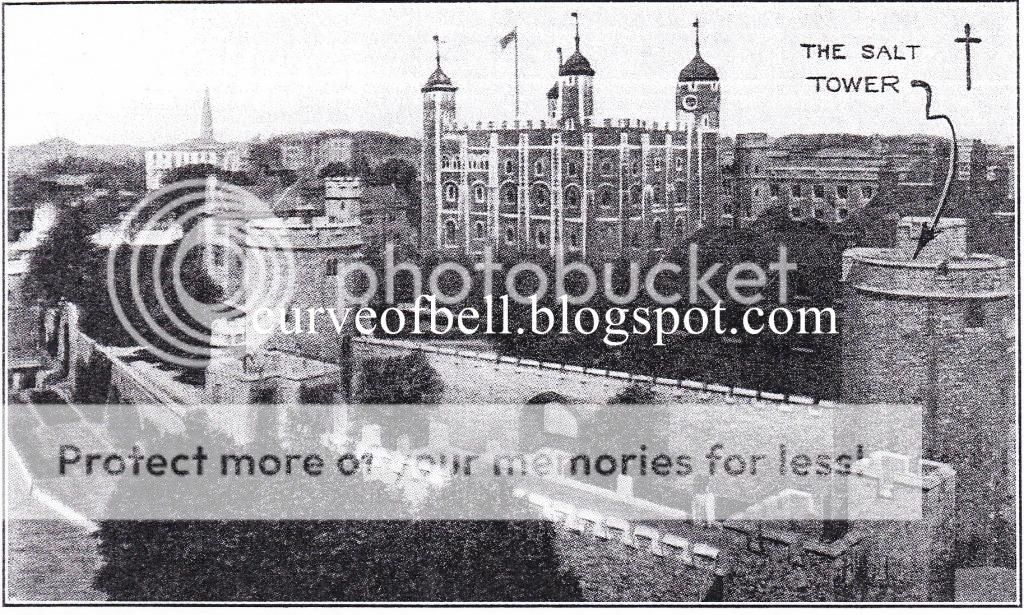
Image source: MacHuisdean, op. cit., p. 47.)
Returning to MacHuisdean’s unexplained emphasis on the Salt Tower as the starting point for siting the Prime Meridian, we note that salt has some relevant connexions that might go some distance towards explaining the Salt Tower’s rôle.
“[T]he salt-cellar partook of the nature of a holy vessel, associated with the temple in general, and more particularly, with the altar.” [88] Salt was both an emblem of “welcome” and “safety” when sitting at table with guests. [89] Additionally, the “salt cellar [served] as a boundary”. [90] In terms of seating arrangements while dining, “the salt dish served as a boundary” – separating individuals of different classes and stations, and “...indicating rank and social position...”. [91]
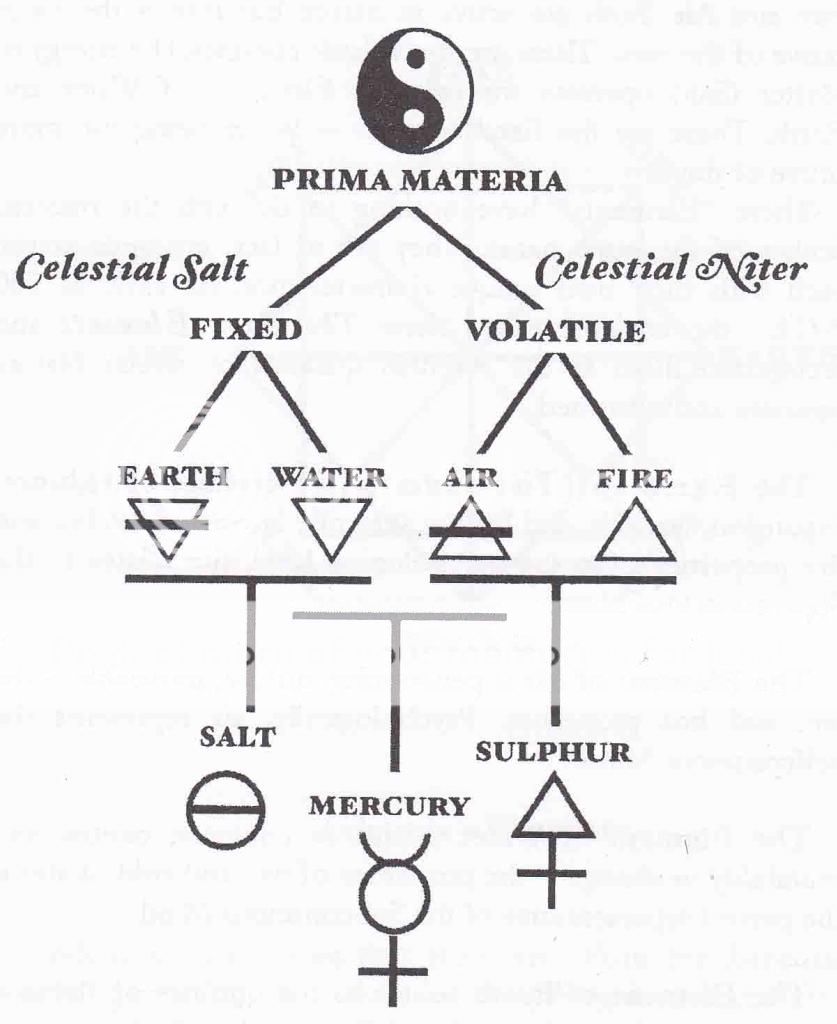

Additionally, Salt – along with Sulfur and Mercury – is one of the “three essentials” in alchemy. [92] Note the capital letters. What is in view is something different from the garden-variety items that answer to the common names salt, sulfur, and mercury.
“Paracelsus defined the Three Essentials by how they behave in fire. Sulfur is seen as what fuels the fire or what is changed in the fire. ...Mercury is the volatile watery essence of the fire that Paracelsus called ‘phlegma’ and is represented by the flames, light, heat, and smoke issuing from the fire. The new principle of Salt exhibits the fixed essence of the substance burning that resists the fire and is found in the ashes. ...As Paracelsus put it: ‘The fire is Mercury; what is burnt is Sulfur; and all ash is Salt.” [93]
Salt is something of a Phoenix. “Like the First Matter, Salt shows up at both the beginning and the end of the work. ...The alchemists described the First Matter as a ‘poisonous dragon’ whose fire can instantly reduce us to ashes.” [94]

In this context, it seems profitable to keep two facts in view. Number one, we should bear in mind the dragon iconography that literally frames the City of London.
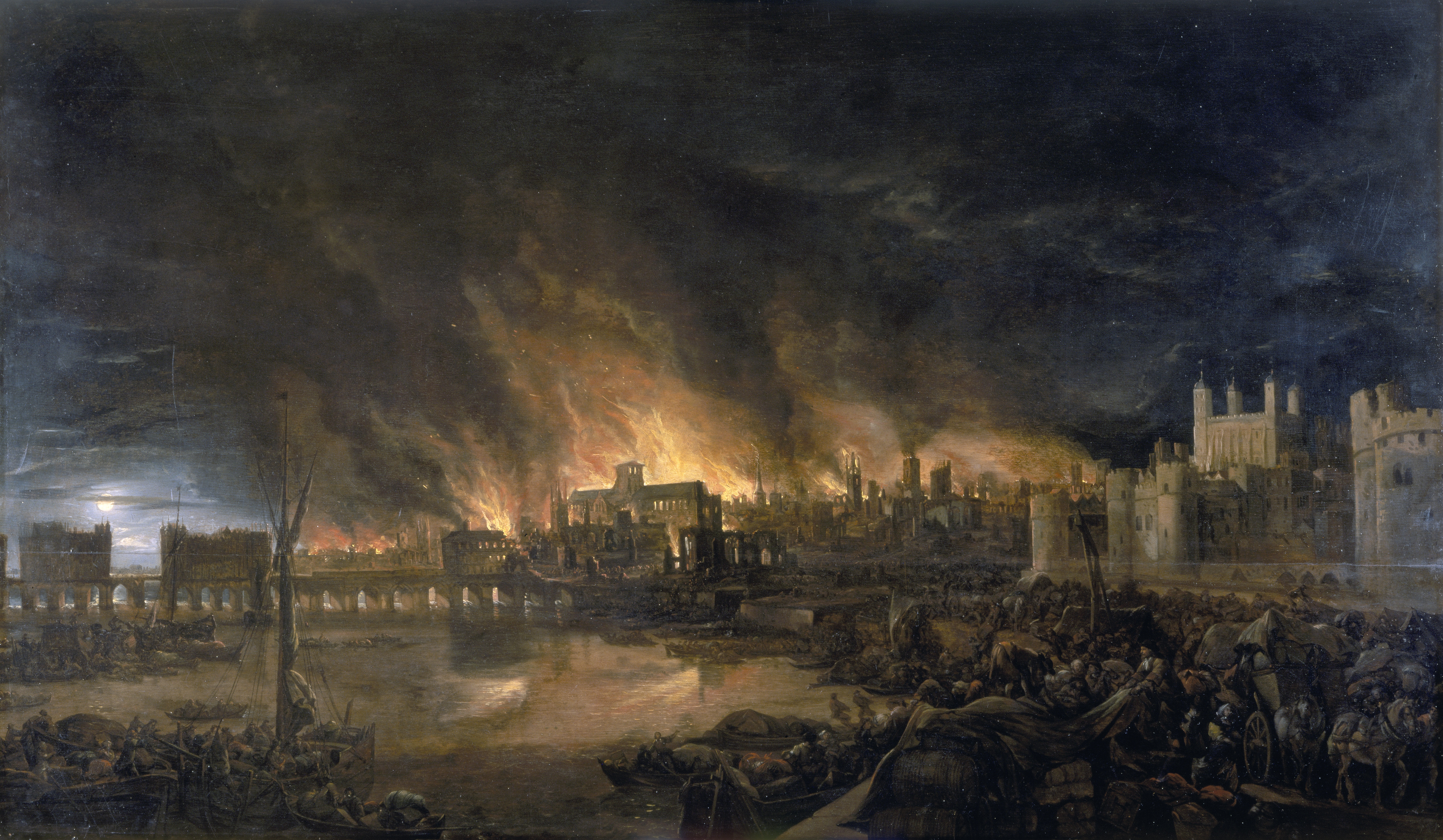
Number two, we should recall the “Great Fire” that occurred in London in the ominous year 1666. [95]
Given the historical context, the pi-distance to Greenwich calculation would certainly have been made only under the supervision of such Royal Society luminaries as the physicist-alchemist Sir Isaac Newton, and the royal astronomer, Sir John Flamsteed.
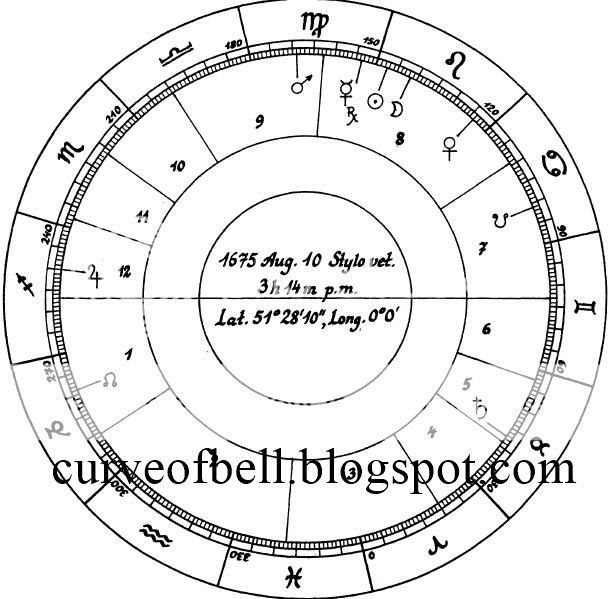
(Image source: Oestmann, loc. cit.)
Although Flamsteed is often said to have been staunchly anti-astrology, he nevertheless personally cast a horoscope for the setting of the Greenwich Observatory’s foundation-stone. [96]
As Greenwich is the locus for the prime meridian, the word “meridian” deserves our careful attention. [97] Literally, “meridian” designates “noon,” and derives from the “... Latin meridianus ‘of midday, of noon, southerly, to the south,’.” [98] “Figurative[ly]...[the word] suggest[s a] ‘point of highest development or fullest power’.” [99]
Indeed, in Freemasonry, the meridian (or noontime) sun represents the so-called “Raised” Mason – the initiate into the Third Degree who now shines “...like the sun at its meridian.” [100] As touched on above, “[t]he government of a Maon’s Lodge...is vested in three superior officers, who are seated in the East, West, and South, to represent the rising, setting, and meridian sun.” [101]
The important 19th century Masonic historian and encyclopedist, Albert Gallatin Mackey, states that the word Zohar (title of the well-known Kabbalistic treatise, which word means, literally, “splendor” or “radiance”) “...signifies the meridian light, the brightest effulgence of day...”. [102] Introduction of Kabbalistic Judaism immediately recalls the Kabbalist-hermeticist, the Baal Shem of London, Dr. Falk, and dovetails, yet again, with the mystical numerology of 72. “The degrees of the Jacob’s ladder were to the number of 72, according to the Zohar.” [103]
Crowley Cavortings on the Meridian?

The established meridian may be thought to identify mystical line, having importance something akin to that attributed to “ley lines” [104] or, perhaps, the 33rd degree of parallel latitude. [105]
Hence, one might expect to discover strange goings on all along the 0-degree line. In fact, it is possible that no less a figure than Aleister Crowley might be summoned (no occult pun intended) at this point to ground this speculation. Crowley’s doings in Africa are often given in vague terms, locatively speaking, using phrases like “in the desert,” etc.
Researcher Alex Owen is more specific. “In late 1909, two Englishmen [Aleister Crowley and Victor Neuburg], scions of the comfortable middle classes, undertook a journey to Algiers. ...It was at Crowley’s instigation that the two men began to make their way, first by tram and then by foot, into the North African desert to the southwest of Algiers; and it was Crowley’s decision to perform there a series of magical ceremonies that prefigured his elaboration of the techniques of sex magic, or, as he was later to call it, Magick. In this case, the ceremonies combined the performance of advanced ritual magic with homosexual acts. ...A little over two weeks after arriving in Algiers, Crowley and Neuburg reached Bou Saada. ...It was here that Crowley, acting on instructions from previous angelic interlocutors, made the appropriate Call and attempted to enter the fourteenth Aethyr.” [106]

(Image source: Google Maps.)
These locations are in northern Algeria. But it is interesting to note that the intersection of the 0-degree line of longitude and the 33-degree line of latitude occurs in Algeria, just northeast of Ain Sefra. It is unclear how much “wandering” Crowley and Neuburg did through the Algerian desert, or how far they managed to go. It is intriguing, however, to speculate as to a possible intention to conduct a ritual along the meridian. One notes, for example, that Neuburg and Crowley reunited in Paris in 1913 for the so-called “Paris Working.” [107] Paris is famous for many things, but as we have already mentioned, one of those things is having an alternate “prime meridian.” [108] To be sure, various factors could have informed Crowley’s decisions regarding ritual locations. One would have to consult authorities sifting through the vast amounts of Crowleyana. Still, it seems worth raising the possibility that Crowley, being a high-level initiate of many systems, may have, to some degree (pun intended this time), been keyed in on the meridian-wavelength.
Early Standard Time in U.S.
“In October 1884, at the behest of the President of the U.S.A., 41 delegates from 25 nations met in Washington, D.C., for the International Meridian Conference. They decided to adopt a single world meridian, passing through the principal Transit Instrument at the observatory at Greenwich, as the basis of calculation for all longitude and a worldwide 24-hour clock. The Greenwich motion passed 22-1; San Domingo voted against it; France and Brazil abstained.” [109]
It turns out that railroads agitated for the standardization of clock times. [110] There was a very pragmatic reason. With different towns all keeping difficult local times, keeping a train “on schedule” was an extremely tricky affair.
It may not surprise the reader, therefore, that in 1860 an important railroad city in Mississippi, the site of the junction of the the Mobile & Ohio and Southern Railways, was named Meridian. [111]
One of the early railroad tycoons, who was also a steamship magnate, controlling the Hudson River (1864), New York Central (1867), and Lake Shore & Michigan Southern (1869), was Cornelius “Commodore” Vanderbilt. [112] “...In the 1860s, Vanderbilt shifted his focus from shipping to the railroad industry, which was entering a period of great expansion. He gained control of a number of railway lines operating between Chicago and New York and established an interregional railroad system.” [113]
Interestingly, Vanderbilt lived in what is today called Greenwich Village, New York. “In the 1840s, Vanderbilt constructed a large brick home for his family at 10 Washington Place, in Manhattan’s present-day Greenwich Village neighborhood.” [114]
In any case, it was Vanderbilt (inter alia) whose influential railroad corporations elicited “...a major transformation of the railroad network, which previously had been fragmented into numerous short railroads, each with its own procedures, timetables, and rolling stock. The creation of a coherent system spanning several states lowered costs, increased efficiency, and sped up travel and shipment times.” [115]
Part of this drive towards efficiency included “Universalizing” time. Official credit for the suggestion of standardized “time zones” goes to the Scottish-Canadian inventor, Sir Sandford Fleming. [116]
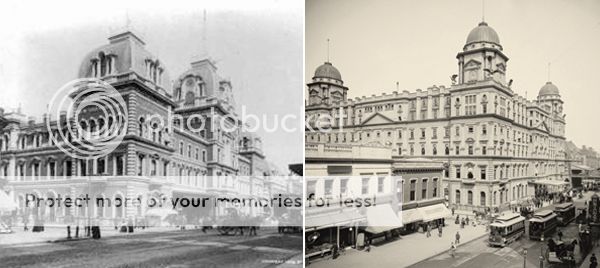
“Vanderbilt was the driving force behind the construction of Manhattan’s Grand Central Depot [left], which opened in 1871. The station eventually was torn down and replaced by present-day Grand Central Terminal [right], which opened in 1913.” [117]
Notes:
[1] Oxford: Oxford University Press, 1998, p. 35.
[2] For an overview, see: “Greenwich,” Wikipedia, <https://en.wikipedia.org/wiki/Greenwich>.
[3] Douglas Harper, “Greenwich,” Online Etymology Dictionary, <http://www.etymonline.com/index.php?term=Greenwich>.
[4] “Nazi Occultsists Seize Omphalos,” London Psychogeographical Association Newsletter, no. 6, Beltaine, 1994. “Pychogeography,” in general, has to do with “the interconnection between landscape and the mind.” Under this description, the subject can be traced back to the 19th-20th century Welsh author, Arthur Machen, whose story The Great God Pan (1890, 1894) remains a horror classic. Psychgeography has fascinated a number of prominent United Kingdom-based writers, including author Iain Sinclair (who is also a British filmmaker), journalist Will Self, and the biographer and novelist Peter Ackroyd. A number of groups have sprung up persuing various psychogeographical investigations. One such group is the London Psychogeographical Association, whose initial founder was the English artist, Ralph Rumney (d. 2002). This association was revamped, and given an anti-Masonic and anti-Royalist orientation, decades later by an anarcho-syndicalist named Fabian Tompsett, under the pseudonym “Richard Essex.” London is not the only city home to persons displaying psychogeographical interest, however. A San Francisco-centric internet gaming community, SFZero, included a sub-group called “BART Psychogeographical Association.” For quotation and more information, see: <http://en.wikipedia.org/wiki/Arthur_Machen>, <http://en.wikipedia.org/wiki/London_Psychogeographical_Association>, and <http://en.wikipedia.org/wiki/SFZero>.
[5] Chesca Potter, “Gazetteer of Sacred Sites in London,” John Matthews and Chesca Potter, eds., The Aquarian Guide to Legendary London, Wellinborough, U.K.: Aquarian Press, 1990, p. 226.
[6] The many-named Shiva has various aspects. “He is a creator god, moon god..., fertility god, lord of the cosmic dance, god of the arts and learning, god of truth, god of luck, god of the rivers, god of the forests, god of death, of yoga, of cremation grounds, and the lingam”, Patricia Turner and Charles Russell Coulter, “Shiva,” Dictionary of Ancient Deities, Oxford: Oxford University Press, 2000, p. 427. Disturbingly, especially in light of its placement beside the controversial Large Hadron Collider, which some fear might destroy the earth (or worse), Shiva is perhaps best known for “represent[ing] the destroyer”, Ibid. Although, Mackey associates “Siva” with “the meridian sun”, in the Southern, preserving, position. See Albert G. Mackey, “SUN,” Mackey's Revised Encyclopedia of Freemasonry, vol. 2, Chicago: Masonic History Co., 1956, p. 988. On the worries regarding the Hadron collider, see Clara Moskowitz , “Will the Large Hadron Collider Destroy Earth?” LiveScience, October 26, 2012, <http://www.livescience.com/32204-will-the-large-hadron-collider-destroy-earth.html>. This “destroyer of worlds” motif also dovetails with the Atomic Bomb rite at the Trinity Site in New Mexico, along the Jornada del Muerto, as James Shelby Downard first noted. See Jim Brandon, "Sirius Rising," interview with James Shelby Downard, with commentary, audio recording, ca. 1976.
[7] Fritjof Capra, “Shiva's Cosmic Dance at CERN,” June 2004, <http://www.fritjofcapra.net/shiva.html>. In addition to the statue, CERN also employs (or did employ) a piece of equipment called the “Shiva router,” see: “Spectrum: Shiva Router Management Guide,” CableTron Systems, 1998, <http://it-div-cs.web.cern.ch/it-div-cs/private/spectrum/Docs/Pdf_docs/shiva_router.pdf>.
[8] Turner and Coulter, “Kali,” op. cit., p. 257.
[9] Shiva's “consorts are aspects of the Great Mother Goddess Devi who appears as Gauri, Sati, Parvati, Uma, Durga and Kali”, Turner and Coulter, “Shiva,” op. cit., p. 427.
[10] The original image, from <http://www.sacred-texts.com/mas/dun/img/00800.jpg>, has been rotated and additional text supplied, for emphasis. The basis of my interpolations comes from Albert G. Mackey, “SUN,” Mackey's Revised Encyclopedia of Freemasonry, vol. 2, Chicago: Masonic History Co., 1956, pp. 987-988: “The Master ...in the East is a symbol of the rising sun; the Junior Warden in the South, of the Meridian Sun; and the Senior Warden in the West, of the Setting Sun.”
[11] Malcom C. Duncan, Duncan's Masonic Ritual and Monitor, New York: Dick & Fitzgerald, 1866, p. 8, <http://www.sacred-texts.com/mas/dun/dun02.htm>.
[12] J. C. Cooper, “Time,” Illustrated Encyclopaedia of Traditional Symbols, London: Thames & Hudson, 1979, p. 173.
[13] Mackey, “TRIAD,” Mackey's Revised Encyclopedia of Freemasonry, vol. 2, Chicago: Masonic History Co., 1956, pp. 1051-1052.
[14] Mackey, “ECOSSAIS,” op. cit., vol. 1, p. 308.
[15] “Greenwich,” Wikipedia, <https://en.wikipedia.org/wiki/Greenwich>.
[16] Mackey, “TIME,” op. cit., p. 1040.
[17] Ibid.
[18] Mackey, “ECOSSAIS,” op. cit., vol. 1, p. 308. The word had been “...engraved...upon a triangle of pure metal...”, ibid.
[19] Ibid.
[20] Michael Whitworth, “Inspector Heat Inspected: The Secret Agent and the Meanings of Entropy,” Review of English Studies, new series, vol. 49, no. 193, February, 1998, p. 55.
[21] Conrad, op. cit., p. 40. This, and the subsequent, reference are owed to Whitworth, supra.
[22] “The Dark Knight (2008): Quotes,” Internet Movie Database, <http://www.imdb.com/title/tt0468569/quotes>.
[23] The Dark Knight, 2008, Internet Movie Database, <http://www.imdb.com/title/tt0468569/>.
[24] Conrad, op. cit., p. 179.
[25] Cooper, “Time,” loc. cit.
[26] James Shelby Downard also made mention of “Call to Chaos” sex magic rites. See, e.g., his contribution “The Call to Chaos” in Adam Parfrey, ed., Apocalypse Culture, revised ed., Los Angeles: Feral House, 1990, pp. 307-327. In Downard's idiom, there are sex and death rites – Call to Chaos and Killing of the King, respectively – that form the core of the novus ordo magic of the Freemasons. The Call to Chaos ritual, which Downard also designates a “sex circus,” is apparently a sort of orgiastic “...[rite] intended to conjure up a theurgic influence of occult forces of elemental nature”, ibid., p. 323. This seems to comport with J.C. Cooper who defines “Orgy” in the following terms: “Re-entry in chaos, the primordial state before creation; cosmic night; dissolution; the lower potentialities of beings...”, op. cit., p. 123. Additionally, both Downard and Cooper link chaos-rites to Saturnalia and the “Lord of the Misrule.” See ibid.
[27] Quoted in Barry Hugill, “Mystics of Avalon, San Francisco Examiner, September 11, 1994, p. A10. (Reprinted from Barry Hugill, “Cultists Go Round in Circles, The Observer, August 28, 1994, p. 3.) The Ackroyd name also crops up in searches on the Tower of London. David Ackroyd narrated Melissa Jo Peltier's production titled “The Bloody Tower of London,” an installment of the History Channel's series “History's Mysteries” (season 6, episode 3, 1999).
[28] <http://en.wikipedia.org/wiki/Woolwich>.
[29] “Woolwich attack: 'Lone wolves’ who run with the pack,” Telegraph, May 25, 2013, <http://www.telegraph.co.uk/news/uknews/terrorism-in-the-uk/10080864/Woolwich-attack-Lone-wolves-who-run-with-the-pack.html>.
[30] Clive Aslet, “Can the clock really be ticking for GMT?” Telegraph (U.K.), October 3, 2011, <http://www.telegraph.co.uk/science/8803144/Can-the-clock-really-be-ticking-for-GMT.html>.
[31] “Paris Meridian,” Wikipedia, April 12, 2013, <http://en.wikipedia.org/wiki/Paris_meridian>.
[32] http://en.wikipedia.org/wiki/History_of_longitude#Problem_of_longitude.
[33] Here I wish to make the interested reader aware of a possible complication. In referring back to Newton, one has to bear in mind that – alchemy aside – Newton's physical theories notably diverge from the Einstein-inspired relativistic physics that was formulated in the 20th century. For one thing, Newton was a substantivalist about time and space. "In the substantival description, space itself is a substance in which the objects of the universe exist and move. ...[Space is]the container, so to speak. ...A similarly substantival description of time is possible. ...Contrast this...with a more relational descrption in which time simply is the changes in physical objects. ...[And space is nothing more than the] physical things [that] exist." Peter Kosso, Appearance and Reality, Oxford: Oxford Univ. Press, 1998, pp. 34-35 and ff.
I quote now from a classic Fortean exploration: “In considering my data it would be helpful to consider a dictum of Einsteinian physics – a science few would accuse of fanaticism or irrationality (although the charges could certainly be made from a rather unconventional perspective): 'Time relations among events are assumed to be first constituted by the specific physical relations obtaining between them',” James Shelby Downard & Michael A. Hoffman II, King Kill 33, Coeur d'Alene, Idaho: Independent History & Research, 1998, p. 11.
Downard and Hoffman invoke Einstein. I have traced the embedded quotation to Adolf Grünbaum: “In regard to simultaneity, there, Einstein's conceptual innovation can be summarized as follows: Time relations among events are assumed to be first constituted by specific physical relations obtaining between them. These physical relations, in turn are postulated to be such that the topological simultaneity of events at spatially separated points P1 and P2 is not a uniquely obtaining relation. Metrical simultaneity is thus left indeterminate by topological simultaneity and by the behavior which the STR postulates for transported, adjacently synchronized clocks”, Adolf Grünbaum, “Reply to Hilary Putnam's 'An Examination of Gruenbaum's Philosophy of Geometry',” Boston Studies in the Philosophy of Science, Robert S. Cohen and Marx W. Wartofsky, eds., Proceedings of the Boston Colloquium for the Philosophy of Science, vol 5, 1966-1968, p. 92.
Grünbaum goes on to explicitly contrast the Einsteinian conception of simultaneity with the conception that follows from Newtonian principles alone. “Therefore, a conventional choice or synchronization rule for which there was no scope in Newton's theory must be invoked over and above the relevant physical facts to assert that a given event at P2 sustains a uniquely obtaining equality relation of metrical simultaneity to an event at P1. In this sense the relation of metrical simultaneity is not an objectively obtaining physical relation in the STR but depends on a conventional choice. For any given event E2 at P2, this conventional choice consists in the selection of a unique event at P1 as metrically simultaneous with E2 from within the infinite class of those events at P1 which are topologically simultaneous with E2. And this choice is implemented by the rule for setting the clock at P2. In brief, Einstein's innovation is that the physical relatedness which makes for the very existence of the temporal order has a structure that precludes the existence of objectively and uniquely obtaining relations of metrical simultaneity. Thus, the failure of our measuring operations to disclose relations of absolute simultaneity is only the epistemic consequence of the fact that these relations do not exist”, ibid., pp. 92-93
Elsewhere, Grünbaum summarizes: “For on Newton's theory, our events E and E' are simultaneous according to its clock readings, and yet they are connectible by Newton's fastest causal chain (gravitation) and only by such a chain. By contrast, the STR requires its clocks to be set so as to issue in the non-simutaneity of any two events which can belong only to the career of its fastest causal chains (light), even though these events cannot both be on the world-line of a single clock”, “Simultaneity by Slow Clock Transport in the Special Theory of Relativity,” Philosophy of Science, vol. 36, no. 1, March, 1969, pp. 21.
Perhaps the simplest takeaway from this abstruse discussion is this: Whatever it is was that Newton took himself to have been doing alchemically or mystically, in terms of coordinating and grounding a standard time, may not automatically carry over to contemporary adepts who are perhaps apt to understand temporal relations along relativistic lines, as opposed to substantivalist ones.
[34] Erlestoke, Wiltshire, U.K.: Erlestoke Press, 1937.
[35] MacHuisdean, ibid., p. 84.
[36] The Kabbalah Connection to pi – The Jewish Kabbalah can’t be a complete unknown even to the mass audience now when popular singer Madonna Louise Ciccone has taken to wearing the red wrist cord of a highly commercialized Kabbalah cult group. We owe to the Israeli mathematics historian, Rabbi Marc-Alain Ouaknin, a number of key insights which tie the pi factor to Kabbalah. The latter, he writes, “designates the mysteries of the mystical Jewish tradition” and he stresses “the essential link of Kabbalah with mathematics.” See Marc-Alain Ouaknin, The Mystery of Numbers, New York, N.Y.: Assouline Publishing, 2004, pp. 153-54. How so?
One of the key kabbalistic concepts is the idea that, for the world to be created, God first “withdrew from himself into himself…thus creating a space for the future world”, ibid., p. 277. However, once the space was opened, it then became necessary to maintain the void and allow the universe to survive. For this a force arose “that kept the light of the infinite at the periphery. In Hebrew, this ‘no return’ force is named shadai, a word that means ‘enough, sufficient’ … Shadai is the name of God, the self-limiting…(in kabbalistic Hebrew, this limitation is called din) whose purpose is to make the Creation possible and therefore to balance entropy and the expansion of the world…”, ibid., p. 279.
Geometry entered the picture when an early Spanish Kabbalist considered the episode (Genesis 3:24) in which God stationed an angel at the Garden of Eden with a revolving sword tracing a fiery circle, and he was inspired to assert “the circle is built from the name shadai.” From that image of the sword (the radius) and the circle it traces, kabbalists extrapolate the equivalent of pi, since the area of the circle is of course determined as pi times the radius squared. Ouaknin explains that, in gematria, in which each Hebrew letter also has a numerical equivalent, shadai equals 314, commenting “Strange coincidence: 314 represents the proximate value of pi multiplied by 100.”
He quotes one Leon Ashkenazi, a contemporary Kabbalist who wrote “Pi is precisely the relationship between the forces that make possible the delimitation in the physical world, a delimitation that exists through the name shadai at a metaphysical level.” It is tempting to surmise that such delimitation is part and parcel of the marking off of the entire globe with the symbolical net based at Greenwich.
The function of time, so primary at Greenwich, enters with a link to another fundamental kabbalistic principle: the creation of the universe through manipulation of the Hebrew alphabet. Ouaknin: “The rational value of pi is 22/7. For the Kabbalists, this number suggests the articulation of the letters of the Hebrew alphabet (of which there are twenty-two) and the numeral 7, whose first meaning is the rhythm of time in biblical thought. Thus, pi (22/7) means the ratio between the alphabet and time, i.e. the word. Indeed, what it does is to put the alphabet in motion, thanks to the combination of the letters”, ibid., p. 280.
Finally, our author concludes: “The ratio that exists between, on the one hand, a tendency toward entropy, deployment and expansion – known by the kabbalistic name of hessed – and,on the other hand, a tendency toward order and limitarion – din – is on the order of pi”, ibid., p. 282.
[37] More on MacHuisdean – Jim Brandon is inevitably reminded of the old kids’ rhyme “Simple Simon met a pieman…” but there is nothing simple in Hamish MacHuisdean’s work-ups. Essentially an anti-establishment geometer, he bases his bona-fides on demonstrated prowess in what were apparently regarded as impossibilities: squaring the circle, trisecting the angle and doubling the cube.
Actually, circle squaring is now not that unusual and has been published in a number of recent sources, and not by methods bearing any resemblance to MacH’s quite intricate procedure. Doubling of the cube has also purportedly been achieved, although a claimed method seen by J.B. in a publication in the 1990s seemed similar to the version first published by MacH in the 1920s. Trisection of the angle may be unique to our author, but as with all of the diagrams given in his books, no attempt has been made by us to verify with our own examples that these techniques really work as he claims.
The most intriguing spin-offs from MacH’s neo-geometry, however, are his assertions on the pi factor. By far his most significant claim is that pi is not a so-called irrational number, meaning one whose “decimals are infinite and unforeseeable…” That is how Ouaknin defines it and follows up with a summary of ongoing attempts reach the end of the series: “Today we are up to more than 200 billion decimals of pi” (ibid., pp. 196, 206) with no end in sight. MacH dismisses this with the claim – which would seem to have revolutionary impact in the maths world if true – that, no, pi ends at 3.1416, period.
He bases this on a complex and, for us, as yet unresolvable series of geometrical diagrams in his book, Yesterday’s Impossibilities (Dunbartonshire, Scotland: Fraser, Edward & Co., 1943). As we mentioned earlier, the present essay is much a work in progress and not a little of that would apply to MacH’s corpus which will be submitted to qualified mathematician-geometers for perusal, as time permits.
Lastly, the Freemasonic connection. Surprisingly reminiscent of the kabbalistic equation of the key Hebrew term shadai to number 314 is MacH’s much-lauded 31460, the 10,000 multiple of his self-contained 3.1416 pi. As an example of his typical development, here is what he produces when considering the “Ratios of the Musical Scale”: “The 2nd note [Re or D] is 432 [vibrations per second: actually, 432 1/8, but he omits the 1/8] or 6 x 6 x 6 by 2. The 13th note [sol or G] is 1296 [v.p.s., also ignoring the extra 1/8] or 6 x 6 x 6 x 6. <>bThe 33rd note is 7776 [v.p.s., omitting 1/8] or 6 x 6 x 6 x 6 x 6. 33 is the Master Mason degree, as all numbers from 1 to 33 added up total 561; and 561 squared and minus 561 yield 314160, the pi ratio series” (Hamish MacHuisdean, The Great Law, Erlestoke, Wiltshire, U.K.: The Erlestoke Press, 1937, p. 160. Emphasis supplied.)
Any reader who wishes to pursue this possible, but not probable, geo-mathematical revolution can probably find MacH’s books through book-finders or interlibrary loans, with a little effort.
[38] Nota bene: The calculation of space (navigational position, longitude, etc.) and time depends upon the sun and moon. This dual-dependence on the sun and moon is very important in alchemy and sex magic as well. See our earlier post: “Neil Armstrong: Astronaut or Alchemist?” HERE.
[39] J. O'Donnell, “John Harrison and the Longitude problem,” Royal Museum Greenwich, November 15, 2002, http://www.rmg.co.uk/harrison.
[40] The Temple and the Lodge, New York, N.Y.: Arcade, 1989, p. 155.
[41] I take the “rose” reference in mathematical, rather than botanical, terms (since the relevant flowers “by any other name” have five petals, rather than six). See <https://en.wikipedia.org/wiki/Rose_(mathematics)>.
[42] “Saturn's Massive Northern Hurricane,” NASA/JPL-Caltech/SSI, photo 1, <http://www.space.com/18674-saturn-vortex-hexagon-storm-photos.html>.
[43] “The hexagram, like the pentagram, was and is used in practices of the occult and ceremonial magic”, “Hexagram,” Wikipedia, May 27, 2013, <https://en.wikipedia.org/wiki/Hexagram>.
[44] “Saturn Hexagon Vortex Storm,” NASA/JPL-Caltech/SSI, photo 6, <http://www.space.com/18674-saturn-vortex-hexagon-storm-photos.html>.
[45] <
[46] “Kronos,” Theoi, <http://www.theoi.com/Titan/TitanKronos.html>.
[47] <http://en.wikipedia.org/wiki/72_%28number%29>.
[48] George Hart, Egyptian Myths, Austin, Texas: University of Texas Press, pp. 40-41, <http://books.google.com/books?id=K78L_vGn2E4C&pg=PA40>. Relatedly, Typhon's plot “to overthrow Osiris” involved “seventy-two fellow conspirators”, Hart, op. cit., p. 41.
[49] <http://en.wikipedia.org/wiki/Great_Year>.
[50]
[51]
[52] See the previous post: <http://curveofbell.blogspot.com/2012/12/threats.html>.
[53] Caitlin Matthews, “The Guardian Head – Sacred Palladiums of Britain,” John Matthews & Chesca Potter, The Aquarian Guide to Legendary London, Wellingborough, U.K.: Aquarian Press, 1990, p. 36.
[54] John Wilcock, A Guide to Occult Britain, London: Sphere Books, 1977, p. 35.
[55] “Christopher Wren – architect and astronomer,” Royal Museum Greenwich, January 28, 2005, <http://www.rmg.co.uk/explore/astronomy-and-time/astronomy-facts/history/christopher-wren-architect-and-astronomer>.
[56] Margaret M. Howard, “Dried Cats,” Man, vol 51, November, 1951, p. 149.
[57] Ibid.
[58] “Sir Christopher Wren (1632 – 1723),” BBC, <http://www.bbc.co.uk/history/historic_figures/wren_christopher.shtml>.
[59] “House of Plantagenet,” Wikipedia, June 1, 2013, <
[60] This meaning is commonly given. Lewis and Short's standard reference, A Latin Dictionary (Oxford, 1879) p. 1382, notes that “Placentia” was also a city in ancient Gallia populated with pagan practitioners of hepatomancy (see: http://en.wikipedia.org/wiki/Haruspex;). The city is now called Piacenza and is in northern Italy, http://en.wikipedia.org/wiki/Piacenza. The Wikipedia article just cited says that the name implies a “good omen”. Although Lewis & Short (loc. cit.) also indicate that the root placer can designate being “...pleased or satisfied with oneself, to flatter oneself, to pride or plume oneself...”, and this is rarely mentioned in conjunction with the Tudor palace, but seems relevant. Finally, “placentia” is arguably very close to placenta, a word (meaning “cake”, esp. “[f]or an offering...” Lewis & Short, Ibid.) that is obviously connected to the omphalos (since the navel is a relic of one's connexion to one's mother via the umbilicus), <http://www.abc.net.au/science/k2/lint/facts.htm>.
[61] Kate Ravilious, “Henry VIII's Lost Chapel Discovered Under Parking Lot,” National Geographic News, February 9, 2006, <http://news.nationalgeographic.com/news/2006/02/0209_060209_london_chapel.html>.
[62] “Greenwich,” Collier's Encyclopedia, vol. 11, Crowell-Collier, 1964, p. 441.
[63] “Greenwich,” Collier's Encyclopedia, loc. cit. There word “Palladian” derives from the name of the “Venetian architect Andrea Palladio (1508–1580)”, <http://en.wikipedia.org/wiki/Palladian_architecture>. It is, however, tantalizingly close to being a LexiLink with the word “Palladium,” about which see In Tenebris. HERE.
[64] The Constitution of Freemasons, 1723; quoted in Frances A. Yates, The Rosicrucian Enlightenment, London: Routledge, 1972, p. 271.
[65] “May 10th, National Maritime Museum, Greenwich,” London Psychogeographical Association Newsletter, no. 6, Beltaine, 1994.
[66] Daniel Lysons, The Environs of London, second ed., London, 1811, p. 504, http://books.google.com/books?id=JJcjAQAAMAAJ&pg=PA504. “During the English Civil War, the palace was used as a biscuit factory and prisoner-of-war camp. Then, in the Interregnum, the palace and park were seized to become a 'mansion' for the Lord Protector”, “Greenwich,” Wikipedia, <https://en.wikipedia.org/wiki/Greenwich>.
[67] Ibid.
[68] “Impressment, colloquially, 'the Press', refers to the act of taking men into a navy by force and with or without notice. It was used by the Royal Navy, beginning in 1664 and during the 18th and early 19th centuries, in wartime, as a means of crewing warships, although legal sanction for the practice goes back to the time of Edward I of England”, “Impressment,” Wikipedia, May 17, 2013, <http://en.wikipedia.org/wiki/Impressment>. Cf. Michael Hoffman, They Were White and They Were Slaves, Coeur d'Alene, Idaho: Independent History and Research, 1993, <www.amazon.com/They-Were-White-Slaves-Enslavement/dp/0929903056/>.
[69] “George I (1714-27 AD),” Britannia, <http://www.britannia.com/history/monarchs/mon53.html>.
[70] “Baron Greenwich,” Wikipedia, March 11, 2013, <https://en.wikipedia.org/wiki/Baron_Greenwich>. According to the aforementioned London Psychogeographical Association [LPA], "Queen Elizabeth, "Her majesty[,] is top dog in the 'occult establishment' - a secret body of Freemasons, many of them titled, who run Britain", Hugill, op. cit. Further, again according to the LPA, the Queen has participated in various Masonic goings on at Greenwich, in and around the Queen Mary palace. See ibid.
[71] Specifically on “The Greenwich Line,” see: “What are ley lines?” London Psychogeographical Association Newsletter, no. 6, Beltaine, 1994.
[72] “Nazi Occultists...”, loc. cit. Additionally, “In Roman times the Thames was narrower at this point, and it is thought that there may have been a ford connecting Greenwich to the Isle of Dogs, where the foot tunnel now runs”, Chesca Potter, loc. cit.
[73] Robert Graves, The Greek Myths, London: Penguin, 1992, p. 772.
[74] Douglas Harper, “Omphalos,” Online Etymology Dictionary, <http://www.etymonline.com/index.php?term=omphalos>.
[75] Raphael Patai, Man and Temple in Ancient Myth and Ritual, New York, N.Y.: Ktav, 1967; cited by William N. Grimstad, “The Freemasons and the Drive to Rebuild Solomon's Temple,” unpublished monograph, 2005, p. 2.
[76] Cooper, “Omphalos,” op. cit., p. 122.
[77] Ibid.
[78] One author handily summarizes the “two main theories about how the Isle of Dogs got its name...”: (1) “...Henry VIII kept his dogs on the island and brought them to his palace at Greenwich by boat if he needed them for hunting” and (2) “...when the Dutch engineers drained the marshes in the 17th century and claimed back the land lost to the 1488 flood, it became known as the Isle of Dykes”, which name survives only in corrupted form. <http://barryoneoff.co.uk/html/the_island.html>.
[79] Chesca Potter, loc. cit.
[80] Hermione Hobhouse, ed., “The Isle of Dogs: Introduction,” Survey of London, vols. 43 & 44, 1994, pp. 375-387; at British History Online, <http://www.british-history.ac.uk/report.aspx?compid=46507>.
[81] See A[nthony]. J. Bell, “Lexi-Links: Nature’s Play on Words,” Fortean Times, August 17, 1976. Mr. Bell has no known relation to the present writer.
[82] Theodore J. Cachey Jr., “Canaries (Fortunate Islands),” <http://www.english.upenn.edu/~dwallace/europe/nodes/canaries.html>.
[83] There is a vast amount of dog-related arcana. We note that “...dogs were sacrificed to [the Greek goddess] Hekate...” who was herself often depicted as dog-headed, Sorita d'Este and David Rankine, Hekate: Liminal Rites, London: Avalonia, 2009, pp. 24 & 71, et alia. We mentioned Hecate in our prior post, In Tenebris (HERE). The Egyptian counterpart to Hermes – the Hermetic god – is Thoth (Tehuti). Although usually represented as a stylized Ibis, “[a]nother of the commonest symbolic forms of Thoth is the dog-headed ape”, G.R.S. [George Robert Stowe ] Mead, Thrice-Greatest Hermes, vol. 1, London: Theosophical Publishing Society, 1906, p. 55, <http://www.sacred-texts.com/gno/th1/th106.htm>. The star Sirius is “...often known as the Dog Star as it is in the constellation Canis, or 'Dog'...”, Robert K. G. Temple, The Sirius Mystery, Rochester, Vermont: Destiny Books, 1987, p. 58. “'[T]he Dog Days'...[follow] the heliacal rising of Sirius in the summer”, ibid. My awareness of this owes to Michael A. Hoffman II, Secret Societies and Psychological Warfare, Coeur d'Alene, Idaho: Independent History and Research, 2001. The conscientious researcher should note yet another obfuscatory word game. Canicula, which means “...literally: little dog...”, is often reported to be “...another name for Sirius”, “Canicula,” The Free Dictionary, <http://www.thefreedictionary.com/Canicula>. On the other hand, “...Procyon was sometimes termed Canicula by the Romans...”, William Smith, ed., “Astronomia,” A Dictionary of Greek and Roman Antiquities, p. 153. Now Procyon (of the constellation Canis Minor) is composed of pro-, which means “before,” and kyon (or “dog”). As I commented in another place, Procyon is most often said to be so-called (the “dog before” or the “before-dog”) because (at least at one time) it was supposed to have risen prior to Sirius (of Canis Major), thus heralding Sirius' arrival. See, e.g., Smith, op. cit., p. 152. However, in other places, the meaning for Canicula/Procyon is given as “little bitch” and carries the connotation of (to put it delicately) “the dog in front” (pro-cyon), Nicolaus Copernicus, “On the Revolution of the Heavenly Spheres,” in Stephen W. Hawking, ed., On the Shoulders of Giants: The Great Works of Physics and Astronomy, Philadelphia, Running Press Books, 2002, p. 129. On this latter construal, the depiction of Canis Minor “in front of” or “before” Canis Major could be taken as a symbolic-astronomic sexcapade, writ large in the stars. This sort of sexual language (talk of a "bitch," etc.) is echoed in the so-called “BDSM community,” which is, in out view, pagan sex magic with a secular veneer. This brief sketch barely scratches the surface. (There is also the possibility of taking a LexiLink approach, here. The root siri, e.g., appears in the name Osiris – O-siri-s, maybe siri-os? Additionally, Cardinal Giuseppe Siri is an important player in some variations of Catholic sedevacantism, see <http://en.wikipedia.org/wiki/Siri_Thesis>. Apple computer has a “Siri” operating system <http://en.wikipedia.org/wiki/Siri_(software)>, and Sirius XM satellite radio is well known <http://en.wikipedia.org/wiki/Sirius_XM_Radio>.) For a bit more information on the star Sirius and related recondite information, see: Jim Brandon, “Sirius Rising,” audio series, ca. 1976; Robert Temple, The Sirius Mystery, <http://www.amazon.com/Sirius-Mystery-Scientific-Evidence-Contact/dp/089281750X>; Michael Hoffman, Secret Societies and Psychological Warfare, <http://www.amazon.com/Societies-Psychological-Warfare-Michael-Hoffman/dp/0970378416>; Loren Coleman, “Dark Knight Shooting,” Twilight Language, July 20, 2012, <http://copycateffect.blogspot.com/2012/07/dark-knight-shooting.html>; and “Sirius Rises,” Visup, July 22, 2012, <http://visupview.blogspot.com/2012/07/sirius-rising.html>.
[84] Douglas Harper, “Canary,” Online Etymology Dictionary, <http://www.etymonline.com/index.php?term=canary>.
[85] “Pictures of the day, Oct. 1,” New York Times, October 1, 2007, <www.nytimes.com/slideshow/2007/10/01/nytfrontpage/20071001POD_12.html>.
[86] “Egyptian god floats up Thames,” BBC, October 1, 2007, <http://news.bbc.co.uk/2/hi/uk_news/england/london/7022829.stm>.
[87] April McDevitt, “The West (imenet),” Ancient Egypt: The Mythology, <http://www.egyptianmyths.net/west.htm>.
[88] Robert Means Lawrence, The Magic of the Horse-Shoe: With Other Folk-Lore Notes, Boston: Houghton Mifflin & Co., 1898, ch. 10, <http://www.sacred-texts.com/etc/mhs/mhs41.htm>. Here is a curious tie-in with our previous study of the Tower of London and our ongoing investigation of Charles II. “In the room containing the crown jewels, in the Tower of London, are to be seen eleven magnificent golden salt-cellars, the oldest dating from the reign of Elizabeth. Of these the so-called state salt-cellar, which is a model of the White Tower, was presented by the city of Exeter to King Charles II., and was used at coronation banquets”, ibid.
[89] Ibid.
[90] Ibid.
[91] Ibid. Lawrence gives the example of a “haughty wife...[who] could hardly be imagined as sitting 'below the salt...”, ibid.
[92] John Reid, “The Three Essentials,” John Reid's Course on Practical Alchemy, part 1, ch. 2, <http://www.levity.com/alchemy/reid1-2.html>.
[93] Dennis William Hauck, The Complete Idiot's Guide to Alchemy, New York, N.Y.: Penguin, 2008, p. 96-97.
[94] Ibid., pp. 97 & 78.
[95] “Great Fire of London,” Wikipedia, February 26, 2013, <http://en.wikipedia.org/wiki/Great_Fire_of_London>.
[96] Günther Oestmann, “John Flamsteeds Horoskop für die Grundsteinlegung der Sternwarte Greenwich,” Sudhoffs Archiv, bd. 86, h. 2, 2002, pp. 129-137.
[97] There is a possibly relevant magnetic phenomenon, namely, the “magnetic meridian” (and declination). “In Magnetism. When a magnetic needle is suspended by a fibre or pivot at its centre it assumes a definite direction by reason of the earth's magnetic force. It lies in a line that is called the magnetic meridian at that spot on the earth's surface, and the more northerly end points to what is called the magnetic north. As a rule the magnetic north at any place will not coincide with the true or geographical north – the magnetic meridian will not be identical with the geographical meridian. The angle between these two directions is called the declination. Thus in London the declination is about 17° west of north; it increases up to a certain limit as one travels westwards, subsequently diminishing to zero in the region of Hudson's Bay. Beyond this the declination is east of north. There are slight daily variations, as well as steady long-period changes, in the declination at any place. Lines drawn on the earth's surface to mark those points where the declination is of the same value, are called isogonic lines. Lines of no declination, where the magnetic and geographic meridians coincide, are called agonic lines. ...”, “Declination,” Encyclopedia123, <http://www.encyclopedia123.com/D/Declination.html>.
“The most remarkable phenomenon of the magnet, in relation to the earth, is the variation of the magnetic meridian in most parts of the globe, upon which depends the declination of the needle. Accurate observation of this phenomenon has ascertained the following facts: There are certain points on the earth where no declination exists. The lines formed by their series, however, do not coincide with the geographical meridians; but, on the contrary, deviate from them very irregularly. According to the most recent observations, there exists a line without declination in the Atlantic ocean, between the old and the new world. It intersects the meridian of Paris, at a southern latitude of about 65°; thence it mounts to the northwest, to about 35° W. longitude from this meridian, or 32° 39' 37” from Greenwich, as high as the latitude of the coast of Paraguay; after which, becoming again almost north and south, it skirts the coasts of Brazil, and proceeds to the latitude of Cayenne. Then, turning suddenly to the northwest, it takes the direction of the U. States, and thence proceeds to the northern parts of the American continent, which it traverses in the same direction. The position of this line on the globe is not immutable ; at least for a century and a half, it has been tending considerably from the east to the west. It passed London in 1657, and Paris in 1664. Thus, in its present direction, it has traversed in the latitude of these places, nearly 80° of longitude in 150 years. But there is no doubt that this change is not uniform. It is even very unequal in different parallels”, “Magnet,” American Encyclopedia, 1851, <http://www.agepedia.org/wiki/MAGNESIA>.
[98] Douglas Harper, “Meridian,” Online Etymology Dictionary, <http://www.etymonline.com/index.php?term=meridian>.
[99] Ibid. The noon and midnight hours are also called the “high” and “low twelves.” “The language of Freemasonry, in reference to the hours of labor and refreshment, is altogether symbolical. The old lectures contained a tradition that our ancient Brethren wrought six days in the week and twelve hours in the day, being called off regularly at the hour of high twelve from labor to refreshment. In the French and German systems, the Craft were said to be called from labor at low twelve, or midnight…[I]n the system of Zinnendorf, it is said that there are in a Mason's Lodge five hours, namely, twelve struck, noon, high noon, midnight, and high midnight…”, Mackey, op. cit., vol. 1, p. 466.
[100] Mackey, “RAISED,” op. cit., vol 2., p. 829.
[101] George Oliver, Signs and Symbols of Freemasonry, p. 204; quoted by Albert G. Mackey, “DEDICATION OF A LODGE,” Mackey's Revised Encyclopedia of Freemasonry, vol. 1, Chicago: Masonic History Co., 1956, pp. 267-268. Mackey subsequently states that “it is a needless task to cite authorities or multiply instances to prove how intimately the sun, as a symbol, is connected with the whole system of Freemasonry”, ibid. But not the sun only. For Mackey reveals that “[t]he sun...[is] obedient to the all-seeing eye...”, ibid. Manly Palmer Hall writes: “The initiate in the mysteries was always instructed concerning the existence of three suns...[T]he disciple is told to revere the invisible sun even more than the visible one”, Melchizedek and the Mystery of Fire, Los Angeles: Philosophical Research Society, 1996, p. 12 (see also p. 18). Mackey writes about the “three sons of Saturn” – Jove (Zeus), Neptune (Poseidon), and Pluto (Hades) – amongst whom “the Universe was divided”, Mackey, “SUN,” op. cit., p. 988. Of course, this is an analog of the Triple Goddess (Trivia) – Luna, Diana, Hecate, ibid. We covered this in In Tenebris, HERE.
[102] Mackey alluding to the commentary of “Doctor Jarvis,” in “ARK, NOAH'S,” Mackey's Revised Encyclopedia of Freemasonry, vol. 1, Chicago: Masonic History Co., 1956, p. 103. Going on, it is stated that the Zo-har of the “Ark of Safety” (i.e., Noah's Ark) is not merely a “...window...but a source of light itself”, ibid.
[103] <http://en.wikipedia.org/wiki/72_%28number%29>. The aforementioned Wikipedia article makes mention of “[t]he 72 old men of the synagogue, according to the Zohar.” I am unaware of the meaning of this reference. There are also 72 hours over the course of three days; 72 pillars outside of the National Archives; 72 bricks on the pyramid of the reverse of the dollar bill; etc. For more "72s," including the crucial 72 divine names in Kabbalah, see Star Trek In Tenebris HERE.
[104] “The Classic Book on Ley Lines”: Alfred Watkins, The Old Straight Track, London: Abacus, 2009.
[105] Cf. Downard & Hoffman, op. cit; as well as Jim Brandon, The Rebirth of Pan, Dunlap, Ill.: Firebird Press, 1983, pp. 170ff.
[106] Alex Owen, “Aleister Crowley in the Desert,” excerpted from The Place of Enchantment: British Occultism and the Culture of the Modern, <http://press.uchicago.edu/Misc/Chicago/642011.html>.
[107] “Aleister Crowley,” Wikipedia, <http://en.wikipedia.org/wiki/Aleister_Crowley>.
[108] “Paris Meridian,” Wikipedia, http://en.wikipedia.org/wiki/Paris_meridian.
[109] Douglas Harper, “Greenwich,” Online Etymology Dictionary, <http://www.etymonline.com/index.php?term=Greenwich>.
[110] “Philosophy of Time: Philosophers Speak,” part 1, Philosophical Installations, University of Oregon, <http://philinstall.uoregon.edu/video/1317/>.
[111] Douglas Harper, “Meridian,” Online Etymology Dictionary, <http://www.etymonline.com/index.php?term=meridian> and “Meridian, Mississippi,” Wikipedia, <http://en.wikipedia.org/wiki/Meridian,_Mississippi>.
[112] “Cornelius Vanderbilt,” Wikipedia, June 1, 2013, <http://en.wikipedia.org/wiki/Cornelius_Vanderbilt>.
[113] “Cornelius Vanderbilt,” History, <http://www.history.com/topics/cornelius-vanderbilt>.
[114] Ibid.
[115] T.J. Styles, The First Tycoon: The Epic Life of Cornelius Vanderbilt, quoted in Ibid.
[116] “Sanford Fleming,” Wikipedia, May 15, 2013, <http://en.wikipedia.org/wiki/Sandford_Fleming>; cf. “Universal Time, Wikipedia, <http://en.wikipedia.org/wiki/Universal_Time>.
[117] “Cornelius Vanderbilt,” History, loc. cit.